Wednesday, August 5, 2015

Maddo's Pipe Dream is the stuff of nightmares for race team sponsorship managers

 Reproduced from Indistincly Wild
A couple of days ago, Nzuma Nfoso — an Ubuntu tribesman in a disputed border region in Central West Africa -- became the last person on earth to watch Robbie Maddison "surfing" on a modified motorcycle, near Tahiti.

This Masai tribesman is not Nzuma Nfoso. He lives about as close to Nfoso as Regina, Saskatchewan is to Tegucigalpa, Honduras. Besides, this guy's got a cell phone; he probably saw Pipe Dream in the first 12 hours it was up.
"That looks like a nice forest," said Nfoso, who his friends call 'the nose'. "I guess he's probably scaring all the animals, eh? It must be noisy. What brand is that motorcycle, anyway? I can't tell."

We froze a frame and ID'd it as a KTM two-stroke, but beyond that I couldn't help him.

"Wow, look at all that water," The Nose said, as the short movie segued into the surfing scene. "I've heard of the ocean, but this is the first time I've ever seen it."

Nfoso was fascinated by the surfers he saw in the background of "Pipe Dream", and I spent quite a bit of time explaining what surfing was. He thought that sounded quite a bit cooler than riding a motorcycle on the water.

"I mean, I have nothing against motorcycles," he assured us through a translator. "When we needed to get sleeping sickness medicine to my village after the rains, a motorcycle was the only way to transport it.

We explained that the water-bike was developed expressly to make this movie, which baffled him. 

"Does DC Shoes make shoes for surfing?” the African asked.

“No. In fact, almost everyone surfs barefoot.”

“Motorcycle boots?”

“Not that I know of.”

At that point, he proudly displayed a set of bright pink Crocs that some American had, years ago, dropped in a donation bin in a suburban parking lot. Eventually they made their way to Africa in a giant container, along with the ‘Affliction’ t-shirt he was wearing. 

“This t-shirt is crap,” he said. “But why anyone needs more than one pair of shoes is unfathomable. And these ones have not worn one bit in the last five years.”

We thanked him for his time.

“Sure, brah,” he said. “Well, I’d better get going. Hope to find a nice snake or rat for the little woman’s pot. Got to be quiet! Lucky no motorcycles in here.” He cocked an eyebrow, flared his nostrils, and disappeared quietly down a game trail.

By now, as that story reprinted from Indifferently Wild makes clear, at this point, everyone on earth has seen DC Shoes’ branded-content exercise Pipe Dream.

What’s less clear, of course, is how many people — if any — will now buy DC Shoes as a result of watching it. You see, while these viral programs are far easier to track than old-school mass-media ad campaigns, it remains quite a bit harder to quantify their impact on sales. In fact, the so-called Millennial Generation that this campaign targets don’t really spend their money on much of anything. (In that way, white American Millennials do have one thing in common with Nzuma Nfoso.)

As a once-and-still-sometimes ad guy, I can’t help but worry about the impact that a shift from paid media to branded content will have on my industry. But as an ex-motorcycle racer I can tell you there’s no doubt at all about the effect such content will have on professional motorcycle racing.

It’s the worst thing ever.

On the face of it, you’d think the rise of branded content would be an additional sales pitch for teams seeking sponsors: “You get access to a bunch of great content,” a team or racer could claim.

But what brands are actually learning is, they can eliminate the racer-middleman and go straight to YouTube, without pausing on the MotoAmerica, Supercross, SBK, or MotoGP grid. AMA Pro flat track? Hah!

Get this straight: It doesn’t matter one whit whether Robbie Madison’s lame stunt actually sells shoes. It doesn’t matter that that noisy, wasteful, no-talent (except for the engineers who designed the system) demonstration only served to irritate a few dozen surfers who actually were doing something pretty cool. Because YouTube views are the new sales, as far as dazzled Millennial marketing executives are concerned.

For whatever that cost DC Shoes — and I guess it was quite a bit, because there are about 24 names on the credit roll, and another 20 or so listed as “water & safety” — DC just scored a bigger win than they would’ve got if they’d outbid Monster Energy for Valentino Rossi’s title sponsorship, which would have cost them an order of magnitude more.

And, not only that, Maddo’s stunt was no risk... to DC Shoes. If it had failed, or gone bad, they might’ve cut together a Jackass style blooper reel, but there was no risk at all of their rider being beaten in public; no risk of an embarrassing breakdown; no risk of a late-season choke. Because there were essentially no witnesses to it, until after it had gone according to plan.

You know, during the tobacco-money-crazed heyday of motorsports sponsorship, series and some riders had their own cachet. Brands wanted their logos emblazoned on Ayrton Senna’s car because they gained something by association. But Robbie Maddison is his YouTube view count. That would worry me if I was DC’s brand manager, but like I said, views and viral propagation are the new money in marketing. These days, a sponsorship ‘win’ doesn’t look like picking a great young rider and grooming him, sticking with him through the ups and downs, and being associated with him while he proves his mettle to the audience of devoted racing fans. Winning doesn’t look like your brand being permanently associated with a sports legend. Nor does winning look like sharing the limelight with other brands on your rider's fairing and leathers, or with event sponsors. Nope, winning looks like being the one and only brand featured in your little movie.

It doesn't matter, either, that most of Rossi's or Marquez' fans can tell you what brand of motorcycle he's riding. It doesn't matter that none of the people watching Pipe Dream will have seen even one frame of video that describes any functional benefit of DC shoes. It doesn't matter that the video doesn't provide a single argument, either logical — or emotional, beyond "they once bankrolled a cool stunt" — for DC over Adidas or even Crocs.

Winning is 10 million YouTube views in a few days. That old way, that’s on life support now. How do you think Marlboro feels about the tens of millions they spent on Michael Schumacher? Their brand’s now associated with a vegetable. That’s even sadder because Schuey was, perhaps, injured by a GoPro camera mounted on his helmet. I guess even he wanted to be a YouTube star.

In another irony, ‘Creativity‘ — a website read by ad industry insiders — mistakenly described Maddison as a ‘motocross star’. Sorry, Creativity; DC and Maddo skipped the long, arduous path to fame that winds through the race tracks of the world.

Don’t get me wrong here, all of the following points are true...
  • The Pipe Dream stunt was lame
  • Robbie Maddison’s done stunts that would scare me to death — just before they actually killed me to death
  • More power to Maddo if DC paid him a fortune to do something I could’ve done.
But if all that brands want from a marketing spend is YouTube views, they’re wasting money on race teams, title and personal sponsors.

The massive viral success of Pipe Dream is another nail in the coffin of racing sponsorships. 

UPDATE: ADWEEK rated Pipe Dream the #1 most watched ad—their word, not mine—in August. 

Saturday, August 1, 2015

Canepa up on assault charges? And memories of other dick moves...

UPDATE: In a long FB post that's reported on Roadracing World, Canepa explained the video by describing a bunch of stuff that went on before this video clip, and saying that he didn't squeeze the other rider's brake, but that he only touched his forearm to get his attention. If there's an official ruling on this from the Italian courts, I'll try to post it.

This track-monitor video is circulating on the internet. It purports to show former EBR World Superbike racer Niccolo Canepa purposely punching the brake lever of another rider, causing him to crash and nearly involving a following rider, too.


I don’t know for sure if it was Canepa, but someone does. In this day and age of hi-res video and computer enhancement, it should be possible to positively ID the machine and rider’s leathers and helmet. It happened at a track day, which baffles me a little bit anyway; I mean really, what does a rider of that caliber get out of riding around with club racers and calamari, anyway?

In any case, Canepa had to sign in, his bike had to have been tech’d; there should be a pretty much ironclad chain of evidence. Apparently, he’ll face assault charges (and if there’s any justice, he’ll be convicted.)

If that happens—i.e., if the guy in this video is really Niccolo Canepa—assault charges should be the least of his problems. World Superbike, the FIM, and the Federazione Motociclista Italiana should hand down a fucking draconian ban. It doesn’t look like the victim of this assault was seriously injured, but he could’ve been killed, and so could following riders.

Whenever I hear of—or see—a really fast guy pull a dick move, I’m reminded of a race meeting at Loudon, back in the ‘90s when NHIS still hosted an AMA National.

Back then, I raced in the LRRS series, so in the support classes that weekend. We had one rider’s meeting for the whole group, so there were AMA Superbike stars standing around with LRRS club racers, some of whom were pretty quick and who were signed up for both the LRRS races and AMA races. After going through the usual patter about flag protocol and the special schedule for a National weekend, the Race Director asked if anyone had anything to add. 

Miguel Duhamel piped up, reminding the fast local guys that the AMA Pros were racing for a national championship. Not to put too fine a point on it, he told them to stay off the track in the final 15 minutes of qualifying, so they wouldn’t balk the stars.

After Duhamel’s suggestion had sunk in a moment, someone in the back spoke up very clearly.

“OK, I’ll tell you what you little runt,” came the retort. “I’ll stay off the track in the last 15 minutes. But if you come past me again and try to kick me, or turn around and give me the finger, I’m going to come to your pit and beat the shit out of you.”

At that, there was an acutal smattering of applause from local fast guys, which made me think that Duhamel had made himself unpopular with more than one of ‘em.

Monday, July 20, 2015

The small matter of life and death in motorcycle racing

The deaths of Bernat Martinez and Daniel Rivas Fernandez, in the final (MotoAmerica) race yesterday at Laguna Seca, serve as a reminder that even on “good” tracks, motorcycle racing will never be safe.

The thing is, risk is what gives the decision to race motorcycles meaning. Although Martinez and Fernandez were, I suppose, technically professionals neither was earning a real living from racing per se. And they certainly weren’t being compensated on the level of other “professional athletes”.

So, why were they taking those risks?

Riding Man was, largely, written to answer that question. I’ve excerpted two small parts of it below. From my perspective, the first helps explain the appeal of motorcycle racing (which has little if anything to do with being an “adrenaline junkie”.) The second explores the way we rationalize risks which, by any rational measure, outweigh our sport’s tangible rewards.

That leaves the intangible rewards. If you’ve been a racer, you know what they are.

Risk is what gives motorcycle racing those rewards. No, we don’t race in order to take risks. But if it was completely safe, none of us would do it. 

Here’s my message to all the racers who didn’t get hurt or killed yesterday. Those guys died for you. Not willingly, of course, but their sacrifice is what gives your sport meaning and what makes the experience of racing so profoundly different than the experience most other sports.

On Saturday night, I opened a play (a first for me; and yes, I was as nervous in the audience as I ever was on a grid.) But it wasn’t as profound an experience as waiting for that flag to drop, because no one’s life was on the line. In spite of my play’s title, I’m an antitheist. So I’ll never suggest anything as puerile as praying for Bernat and Daniel, and please unfriend me if I ever repeat that trite, “Godspeed”.

But you should hold them in your thoughts, because they and so many others who went before them will make your next race a profound experience. Their deaths will impart that much more meaning to the feelings you have when you pull off the track after next taking the checkered flag.

ON RISK Pt. 1

Hemingway is famously quoted (or, perhaps, misquoted?) as having said, “There are only three sports: bullfighting, motor racing, and mountaineering; all the rest are merely games.” This is ironic, because as a motorcycle racer, I’ve always been jealous of mountain climbers, in the sense that they don’t seem to face the same resistance from society when it comes to justifying or explaining their obsession. If you grow up in Switzerland and then live in the Canadian Rockies like I did, you meet lots of climbers. I’ve known about half a dozen people who’ve summited Everest, and I’ve always been struck by the fact that we seem understand each other well. We both appreciate a kind of self-knowledge that comes from our particular risk sports. 

There are equally dangerous–even more dangerous–pursuits. You could choose to be a rodeo bullrider or base jumper. But the danger in those sports comes from the decision to participate. It’s something you confront once per event, when you lower yourself down from that eight-foot fence and wrap that rope around your hand. You nod, and after that your survival is up to the bull. For all the control you have over it, you may as well be playing Russian roulette. In fact most winning rides are, if anything, less dangerous than losing ones. But climbers and motorcycle racers need to make a constant series of decisions–we ask ourselves, “Where’s the edge?” and constantly need to confront the fact that after removing every possible variable we’re going to be left with this reality: the best performance is inherently the most dangerous one. This is the source of a unique kind of self-knowledge and an easy mutual respect between us. 

And yet, motorcycle racers get far less credit for this in society at large. No one seriously suggests that climbing should be outlawed. I blame this discrepancy on George Mallory. He’d attempted to climb Everest in 1922, and was on a lecture tour of America raising money for a second attempt. At every stop, he got the same stupid question from reporters, “Why do you want to climb the world’s highest mountain, anyway?” Finally, in exasperation, he snapped “Because it’s there!” 

For whatever reason, the answer resonated with the non-climbing public. Taken out of context, the phrase had its own Zen. 

Mallory did assemble the sponsorship he needed for a second attempt, in 1924. Whether or not he made it to the summit is one of climbing’s enduring mysteries. He never came back down and was never seen alive again. Considering the equipment of the day (for perspective, the TT course record was around 55 miles per hour at the time) his climb was one of the greatest achievements ever in mountaineering. Mallory’s record stood for 30 years until Sir Edmund Hillary became the first man ever to summit Everest for sure. 

ON RISK Pt. 2

One of the places that’s been bugging me–frankly, scaring me–on the course is Barregarrow crossroads. Two gnarly, blind, left-hand kinks, connected by a steep bumpy downhill. But one day as I’m riding along on my bicycle, I come to the farm just before the crossroads. There’s a huge tree on the left here, and I’m making a mental note that I need to be way over to the right, in position for the first kink, by the time I get to this point. As I’m pedaling beneath the tree, I hear a cacophony overhead. Hundreds of crows are living up in the branches. In fact, the road is plastered with their shit, which is another reason to be over to the right. 

But crows. Suddenly, I’ve lost my fear of Barregarrow. 

All this goes back quite a few years. Once, I signed up for a California Superbike School session on a Honda RS125 GP bike. The school took place at Willow Springs, on the Streets of Willow practice course. As usual, I didn’t know anyone there. My lupus was acting up. Every joint really hurt, and the prospect of folding myself onto one of those tiny, tiny bikes was not that appealing. As a Canadian in the ’States, I had no health insurance. All in all, as I waited to get started, I figured I’d put myself in a very good position to make a fool of myself at best, break my body and my bank account at worst. 

I was distracted from these glum thoughts by a flock of ravens about a hundred yards down the pit wall. They were fighting over treasure: a bag of old french fries. Suddenly, for no reason, I had a sense that these birds were good luck for me and that as long as they were there, I was going to be all right. This belief sprang fully formed into my head. Like other people, the things I believe most fervently are based in utter nonsense. 

Ever since then big, noisy black birds are good luck for me. I’ve always felt that–especially on the morning of races–if I see one it’s a guarantee I won’t be hurt. And it’s always been true. 

Long after that day at Willow, in the course of my advertising career, I had to write some public service TV spots on the subject of gambling addiction. I went to a few Gambler’s Anonymous-type meetings where I learned two things. One was that gambling addicts were pathetic losers. The other was that this irrational belief that something is lucky for you has a name. Psychologists call it “magic thinking” and it is one of the hallmarks of risk addiction. 

In fairness, the big black birds have always worked for me. They’ve protected me on days I’ve seen ’em, and indeed, I’ve had some hairy crashes on mornings when I’ve not seen them. If you set out to debunk my talisman, you’d say, “The birds calm you, and you ride better relaxed. You’re tense when you’re aware you haven’t seen one, and you ride shitty tense.” That may be true. The scientist in me is a little subtler. I think that the birds are common, after all, and there’s probably almost always one to see. I think that when I’m in a state of relaxed awareness, alert to my environment, I can count on seeing one. That’s the state in which I ride well. When I internalize, when I’m looking in and not out, I don’t see them. That’s a state in which I ride poorly. 

Whatever the case, after the TT fortnight was over, I drove one of my visitors to the airport, and on the way home crossed the Fairy Bridge. Somehow, lost in thought, I failed to say hello, though I reassured myself that I’d said it on the trip to the airport and according to the letter of the legend, it is the first crossing of each day that is critical. Nonetheless, most Manx say hello on every crossing, and that had been my habit too.


Monday, June 29, 2015

Gaming the rules is part of the game

I see that the Grand Prix Commission—that's actually French for "big pricks"—have decided that Ducati will lose its rules "concessions" a year earlier than previously thought. I guess Honda and Yamaha got tired of Ducati riders qualifying and finishing ahead of their factory bikes.

The reason this bugs me is, gaming the rules has always been a part of the game in motorsport. Looking at the rulebook and figuring out how to get an advantage is one of the central skills in racing. Ducati did that better than Honda and Yamaha; they should be rewarded for it, not punished for it.

Bad form, MotoGP.

Thursday, June 11, 2015

Best-laid schemes

It's hard to decide which recent PR faux pas was worst, between Harley-Davidson's full court press at the X-Games (in which race leader Jared Mees' Harley expired on the last lap) or Honda's high-profile unveiling of the RC213V-S.

The reaction to the Honda's specs has been one of pretty much across the board disappointment, in the sense that they claim an underwhelming (by modern standards) 101 hp at an overwhelming price that's near enough $200k.

Seriously? And the curb weight is more than a stock CBR600.

Ironically, both those PR hiccups redounded to the benefit of Kawasaki. Bryan Smith inherited the X-Games gold medal, and then about the time the embargo was coming off the Honda story, Kawasaki scooped 'em when James Hillier hit a verified 206 miles per hour on public roads, riding the H2R on an Isle of Man parade lap.
The best-laid schemes o' mice an' menGang aft agley
I put the question to Facebook: If you could have one bike only, and had a $5k budget to buy it, what would it be? My purpose is mainly short trips in town and I need reasonable weather protection and cargo capacity. Bonus points for long-distance and/or sport-touring capability, bonus points for bad road capability.

Of course, the KLR and V-Strom supporters soon commented in numbers, and I suppose there's a good chance that I'll go that route. I'm not really in the market yet; I have to sell at least one more bike to fill up the cash hopper.

It's an interesting point to ponder, and I've imagined myself on everything from a Burgman to a mid-'90s VFR750, to any number of BMWs. My wildcard entries range from a Piaggio 3-wheeler (which do, surprisingly, show up on the KC Craiglist every now and then) to a first-gen Ducati Multistrada (which is a bike I love, but that never shows up on CL.)

Anyway, I will obviously write about it when I buy a new bike. In the meantime, my Dream and the Bonneville are both in new homes. My TLR200 is on CL, as is the Vino, but I've priced the Vino pretty high just because it's so useful to me.

Best-laid plans, redux

David Emmett recently wrote that Honda's MotoGP effort has been in a long, slow decline masked only by Marc Marquez' rare talent (and affinity for the "real" RC213's too-aggressive throttle response.) I suppose this proves that, as of yet, the rider's wrist still counts for something; it's not all down to computers.

But I can't help but remember the times we've been through this before. Only Stoner could ride the Ducati. Even Rossi was hopeless on it. And of course, only Wayne Rainey could make the Yamaha 500 two-stroke work in the early-to-mid '90s. After Rainey was paralyzed, a string of very talented guys were stymied by that bike.

When it comes to developing a race bike, it seems there is such a thing as too much talent—if it masks underlying problems or at the very least, takes pressure off the engineers.


Monday, May 25, 2015

Nerd alert: Bayliss' progress at Springfield, analyzed

No reasonable person expected Troy Bayliss to make the Main at his first Grand National. Overall, I'm sure Troy, the Lloyd Bros., and Ducati are all pretty happy with what went down in Springfield, although their weekend would've been a lot better were it not for Johnny Lewis' scary crash.

Bayliss' lap times trended down, although by some measures, all of his improvement relative to the rest of the field happened right at the beginning of the day. From Q1 on, Troy tracked along about two seconds adrift of the fastest guys.

The most interesting statistic is that, in his 8-lap Semi, Troy finished only about 7 seconds behind Jake Cunningham—the last guy to go through to the Main Event. I calculated a "Cutoff Factor" of 102%, meaning that Troy's lap times in that critical Semi were about 2% longer than they needed to be.

For all I know, Troy may make the Main at Sacto; it's a horsepower track that should suit the Ducati, although the Lloyd Bros. and Jake Johnson elected to race their Kawasaki there last year.

If Troy doesn't make the Main, I'll be looking to see improvement in that Cutoff Factor. If he does, I'll use the same statistical analysis next week to analyze his performance vis-a-vis the front runners.

In the meantime, if you want to waste 15 minutes of your life, you can watch a seriously boring and pedantic analysis of his lap times at Springfield. (I promise to get to the point quicker next Monday, after Sacto!)


Monday Morning Crew Chief from re: RevolutionaryOldIdea.com on Vimeo.

Wednesday, May 20, 2015

More photos from the auction at Steelville and Cuba, MO

Manx Norton was, according to rumors, part of the "good stuff" that got burnt up in a fire at the farm.

Somewhere, there must've been a box with all the missing fuel caps.

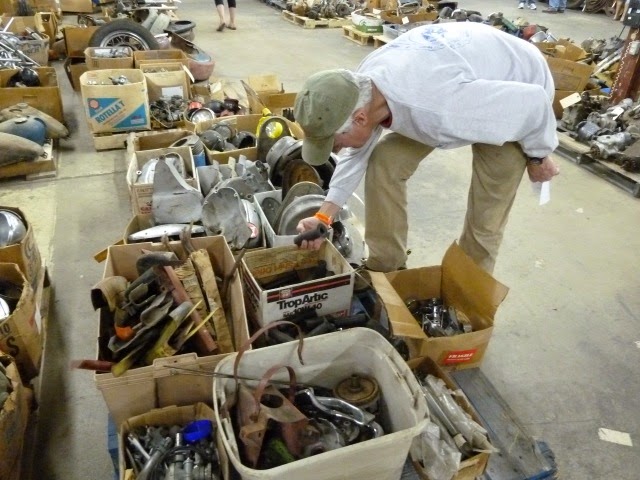
Lots of great finds, but only for those willing to buy in volume. This was one lot.

These went for $5,000 a piece. Granted, they were in perfect shape. Not sure if they were rebuilt or NOS.

Even after two months' work, Wood's crew was still overwhelmed by the quantity of material, and the unique challenges of Jerry L. Lewis' hoarding disorder.

Wheels. Again, one lot.

Panther found in Missouri woods.

There were some cool bikes, but the hoarder's taste ran the gamut.

Wooden rims!

Wood pulled several hundred bikes and pallets of parts out of the farm, and moved them to an empty industrial building in nearby Steelville. This was the site of the first-day auction.

Lots of small bikes that I can hardly imagine were that common in these parts. My friend Jim wondered how many had come back with servicemen, from Europe. Fort Leonard Wood is right nearby.

This pretty complete looking Guzzi sold for $20,000. The bidder was buying it for a friend in Switzerland. Later I heard that the friend's reaction was, "You paid how much?"

OHC, twin-ports. Star of show. $30 grand.

Graphic design gems abounded.

This pair sold for over $10 grand(!!!) A few days later, one every bit as good was advertised on Craigslist here in KC for $600. Most of the machines were sold sans title, by the way.

$27,000 worth of 1915 Harley.


Treasure for some Yale restorer. This was one of the few parts sold individually. Another was a Hedstrom carb, that went for over a grand.

Most of the parts were sold like this, by the pallet.

If I was writing a thesis on industrial design, my topic would be these beautiful outboard motors...


Another single lot.

Most of the bikes were in pretty rough shape, but a few crate motors looked ready for gas and oil.

Another star of the show. I think this one went for about $30 grand.

Another bit of sweet logo design.

Sold by Ed "Iron Man" Kretz!

My friend Jim Van Eman scored this Mornini. "I have two Morinis now," he told me. "Does that make me a moroni?"

Patina? Yes. Motor? Sadly no.

Better days seen...

Do you know how fast you were going?

Lights.

Hip, daddy-o.

Jim's genius idea came too late; they should've had a swap meet right after the auction, so the people who bought whole pallets of stuff could swap amongst themselves to get what they really wanted...

Tanks for the memories.

We were evidently not supposed to be here, but...

…we ignored the signs to explore the farm, too.

Burnt up in the fire?

It's hard to know exactly how they decided what to leave on the farm for the second day's auction.

There were a few bikes out there which had burnt or melted alloy bits, but the steel'd survived. (Sort of.)

Subaru Ladybug. Powered by 600cc two-stroke motor, IIRC.

Nice lettering from a time, happily, before vinyl.

Advantage of metal buildings: They don't burn.

Lewis accumulated quite a few bicycles, as well.

'80s Yamaha, ISO motor.

Bottom, ISO top.

I think Lewis had some kind of mobile home that burnt up. I'm not sure if this is where he lived afterwards...

NSU Lux: The only two-stroke they ever made.

Who knows what evil lurks in the hearts of men? The Shadow knows.

500 bidders showed up.

There was a box of about a dozen of these, which have to be treasure for the right hunter.

Even Jerry Wood seemed a little surprised by the bids on some items.

Southeastern MO: Rat-tail heaven.


"He was a loner." This guy was one of Jerry L. Lewis' few friends.

Manx Nortons were hot bikes.

When Brownie prepared to unload the Adler from the trailer back in Lawrence, KS, he noticed that the motor had turned 90° in the frame; it had not been bolted in, it was just sitting on the lower frame rails the whole time!