Last week, I ran across this in my Twitter feed:
I thought that was a good question, and I retweeted it. And that was retweeted, etc. I've spent the last few days in a sort of slow-rolling conversation over social media, with people saying basically, "Well of course he's insured" [I think] and "Class of '79 is gathering money for other expenses, such as the expenses of his family, staying near the hospital" [I think].
Cycle News ran a story from AMA Pro the other day explaining that "To clarify yesterday’s statement: Funds raised will be used to cover expenses above and beyond medical insurance and support provided by Indian Motorcycle, his sponsors and existing additional support."
To be clear, I've not heard from anyone at Polaris. I haven't heard from Brad or anyone in his family – though Brad and I have had enough of a journalist-subject relationship that I now almost consider him a friend, as well as a source. So I don't fucking know what insurance coverage he's got, or what the financial implications of his recent crash will be.
I do know this: Earlier this year, I had a conversation with Brad in which he told me that while Jared Mees was essentially a freelancer, running his own operation out of Kenny Tolbert's shop in Texas, that he and Bryan Smith were "employees". His word.
So maybe Mees is responsible for his own insurance coverage, but what about Baker and Smith? I imagine that insurance and disability coverage are defined in their contracts with Polaris. I imagine that AMA Pro Racing also provides some supplemental coverage (which would seem typical for a sanctioning body) and I imagine that part of the licensing procedure is showing proof of medical insurance. I've often had to attest that I was insured in order to go racing, but I've never had to actually provide proof of valid coverage. Many amateur racers who rely on employer-provided coverage are probably not covered because there are lots of insurance contracts that specifically exempt the insurer for responsibility for injuries incurred in any speed contest.
To recap, I know fuck all about Baker's actual insurance coverage. Anyone who wants to fill me in, on or off the record, please contact me.
None of this is a diss in any way on the Class of '79 charity. I just wish it wasn't needed in this case.
I wish no one needed the Class of '79 to step in and help out with medical expenses. But it certainly shouldn't be needed when a factory rider gets hurt. That kind of help should be reserved for cash-strapped privateers. Brad might need a lot of help right now, but whatever he needs, it should not be money to "cover expenses above and beyond medical insurance and support provided by Indian Motorcycle..." etc. It would be a lot better if word came back right away, "Thanks for your prayers and best wishes but please don't worry about money; Polaris has that part covered."
Baker is justifiably popular with dirt track racers and fans, and the various fund-raising efforts will probably generate a significant sum most of which will be donated by people who specifically want to help Brad. Whatever amount is disbursed to Brad and his family by the Class of '79 or other charitable groups, that amount should be donated by Polaris, back into the Class of '79's fund for use in the future by privateers who can't expect the support of a multi-billion dollar company.
Funny thing about the Class of '79, which included Wayne Rainey: those were the days when the Grand National Championship exported riders to the World Championship. For a while, the U.S. dominated Grands Prix. Now, we bemoan the scarcity of Americans at the top level. There are a lot of reasons why Europeans now dominate – not the least of which is, we taught them how to race dirt track! But one contributing factor is the Euros all come from places with nationalized health care: They don't have to factor in either outrageous annual insurance costs or the risk of a medical bankruptcy after a serious (or even relatively minor) injury.
Yes, the cost of health care is ridiculous in the U.S. – far higher than in any other first-world/developed nation, all of which have better population health outcomes than we do. I would not be surprised if the total bill for Baker's treatment runs to seven figures, and the reality is that if it'd happened to Marc Marquez in Spain, there wouldn't even be a bill.
That's not Polaris' fault, but Polaris certainly knew what it was getting into when it decided to go racing. Now it should step up. It's great that the Class of '79 was so quick to cobble together a fund-raising program, but it should not have been needed in this case.
Riding Man author Mark Gardiner provides insight into motorcycle racing, history, and industry news. A focus on road racing is to be expected from an ex-Isle of Man TT racer but Backmarker also covers everything from flat track to electric bikes.
Showing posts with label Monday Morning Crew Chief. Show all posts
Sunday, July 29, 2018
Saturday, December 9, 2017
Going deep on motorcycle death rates
Earlier this week, I had one of those business trips where–right
after landing in Washington, DC before even leaving the airport–I checked in
for my flight home. So, I was destined to spend even less time in Washington
than a typical West Wing staffer.
The purpose of my trip was to attend the initial meeting of
the Motorcyclist Advisory Council, a 10-member committee assembled by the
Federal Highway Administration, and charged with presenting recommendations to
the Administrator on infrastructure issues of concern to motorcyclists. This is
a broad remit, covering everything from the design of road barriers to V2V and other ITS technology.
One of the first presentations was essentially a statement
of the problem: Motorcycles account for an increasingly disproportionate share
of all road fatalities. While we account for less than 1% of all Vehicle-Miles
Traveled, we make up over 14% of all road fatalities.
This presentation was made by MAC member Chanyoung Lee, who
is on the faculty of the Center for Urban Transportation Research at the
University of South Florida. What follows are my own comments, based on Dr. Lee’s
talking points.
Even at a glance, you can see that it’s not really as simple
as, “Car deaths are decreasing, but motorcycle deaths are increasing.” Both car
and motorcycle deaths have been holding relatively stable so far in this
decade. But let’s look at a few interesting spots on this graph...
1–Sharply rising deaths in the late ’70s
Deaths rose sharply in this period, perhaps influenced by a
double-whammy of widespread helmet-law repeals in the middle of the decade,
followed by a gasoline price spike (which, at least anecdotally, is associated
with people commuting on fuel efficient motorcycles.)
2–This trough in the ’90s tracks with a period of very slow
sales
Deaths dropped to into the low 2000s in the ’90s. More than
anything else, this likely reflects the fact that throughout that decade, only
about a quarter of a million new bikes were sold per year in the U.S. Fewer
new-bike sales isn’t a perfect analog for the number of new (read: most
at-risk) riders, but it’s the best corollary that I have at my fingertips.
Between the late ’90s and the 2008 crash, however, we make up for lost time by
killing ourselves in sharply increasing numbers. This curve tracks almost
perfectly with new bike sales.
3–Car fatalities level off. Or do they?
From the early ’90s until the mid-2000s, it looks as if car
deaths have leveled off. But in fact, this is a period in which autos become a
lot safer. The key to understanding these numbers is to realize that what
matters is the rate of death per vehicle-mile traveled (VMT). According to the
FHWA, Americans logged about 2.25 trillion VMT in 1992. That number increased
to over 3 trillion VMT by 2007. Auto makers likely deserve most of the credit
for holding fatalities largely steady.
4–The recession hurt undertakers too, I guess
The sudden drop in motorcycle fatalities after 2007 is
explained by an even more dramatic drop in new bike sales, from a peak of about
1,125,000 in 2007 to barely half a million in 2009. Meanwhile, if auto makers
could be proud of holding deaths constant in spite of the fact people drove
more through the ’90s, they can bust their buttons over the long and impressive
drop in auto fatalities from the early ’aughts to the early ’teens. Widespread
adoption of advanced safety features like airbags and ABS. The real question is, as dangerous old cars
continue to age out of the total fleet, why hasn’t this trend continued? More
on this later.
This photo’s a tad underexposed; sorry. The blue bars are
deaths of riders under 29, the red bars are riders 30-49, and the green bars
are riders over 50.
5–“Every new motorcycle sold with FREE body bag”
From the late ’70s through the early ’80s, the vast majority
of deaths are young riders. At a glance, all the red bars appear about the same
from the late ’70s until the mid-’90s. And those little green caps, indicating
deaths of riders over 50, seem both constant and trivial.
6–When sales crash, riders don’t
The sales crash of the 1990s corresponds with a drop in
young rider fatalities, but no apparent drop in older, and presumably more
experienced, rider deaths.
7–“Let’s blame the old guys”
From the early ’aughts until now, younger rider deaths have
held roughly steady (that slight rise in the early-to-mid ’aughts tracks
perfectly with the last heyday of supersports-class sales.) Meanwhile deaths of
over-50 riders have increased significantly. The easy conclusion: Suddenly
there’s a bunch of crotchety old farts who can’t admit they should stop riding;
they’re a hazard to themselves. But it’s not that simple, as the next graph’s
open to at least two very different interpretations...
This graph looks at the number of fatalities by age of
rider. The blue line compiles rider deaths in the 2003-’05 period, while the
red line compiles deaths in the 2013-’15 period. It is a pretty cool
visualization if you’re into stats, and it looks like the final proof for the
doddering-old-fool theory of increased motorcycle fatality. Because, the two
lines look remarkably similar but the later stats are all pushed to the right. But–and
if you know me at all, this will come as no surprise–that’s not how I read it.
Are more older riders dying? Of course. But this graph provides no evidence
they’re dying because they’re older.
8–It’s 2013. Do you know where your kids are?
Not if you’re a motorcycle dealer. And that very steep rise
between riders in their late teens and those in their early twenties simply
reflects the fact that your first couple of years on a full-power motorcycle
are as dangerous than all the subsequent ones.
The shift in very young fatalities is visible–those early
deaths peaked at 21 in the early ’aughts, but at around 24 a decade later. But
the rightward/older shift’s nowhere near as dramatic as it is amongst older
cohorts. This shift almost certainly reflects something anyone in the business
knows intuitively; there are fewer really young riders out there.
9–The early ’aughts seemed to have been a dangerous time for
30- and 40-somethings
That’s weird, eh? Or is it?..
10–Anyone in the motorcycle business between 2003-’13 knew
buyers were getting older
Look at those two peaks: the blue peak by 9 and the red peak
by 10. In the decade that separates these two sets of statistics, the average
age of a motorcycle buyer increased by about a year with each passing year. All
that rightward shift really means is that in 2013 when someone said, “Fifty is
the new 40” they were right, at least where motorcycle buyers were concerned.
In fact, those two peaks are actually comprised of the very
same cohort, seen ten years apart.
11–It’s easy to look at that red line shift and say, “Obviously,
older riders are crashing more,” but you could only draw that conclusion if you
had access to numbers no one has ever seen: motorcycle VMT by rider age–information
that is not available as far as I know.
Anecdotal, I admit; but I am pretty confident that the
larger number of older-rider fatalities reflects a far larger number of older
riders, including older novices and/or riders returning after gaps so long they
might as well be novices.
Look at the way the lines appear to converge for riders in
their mid- to late-60s. If my gut instinct is correct, and there are a lot more
riders in this cohort now, it suggests that today’s older riders are as safe as
they ever were. Personally I suspect that at least where motorcycle safety’s
concerned, seventy really is the new sixty.
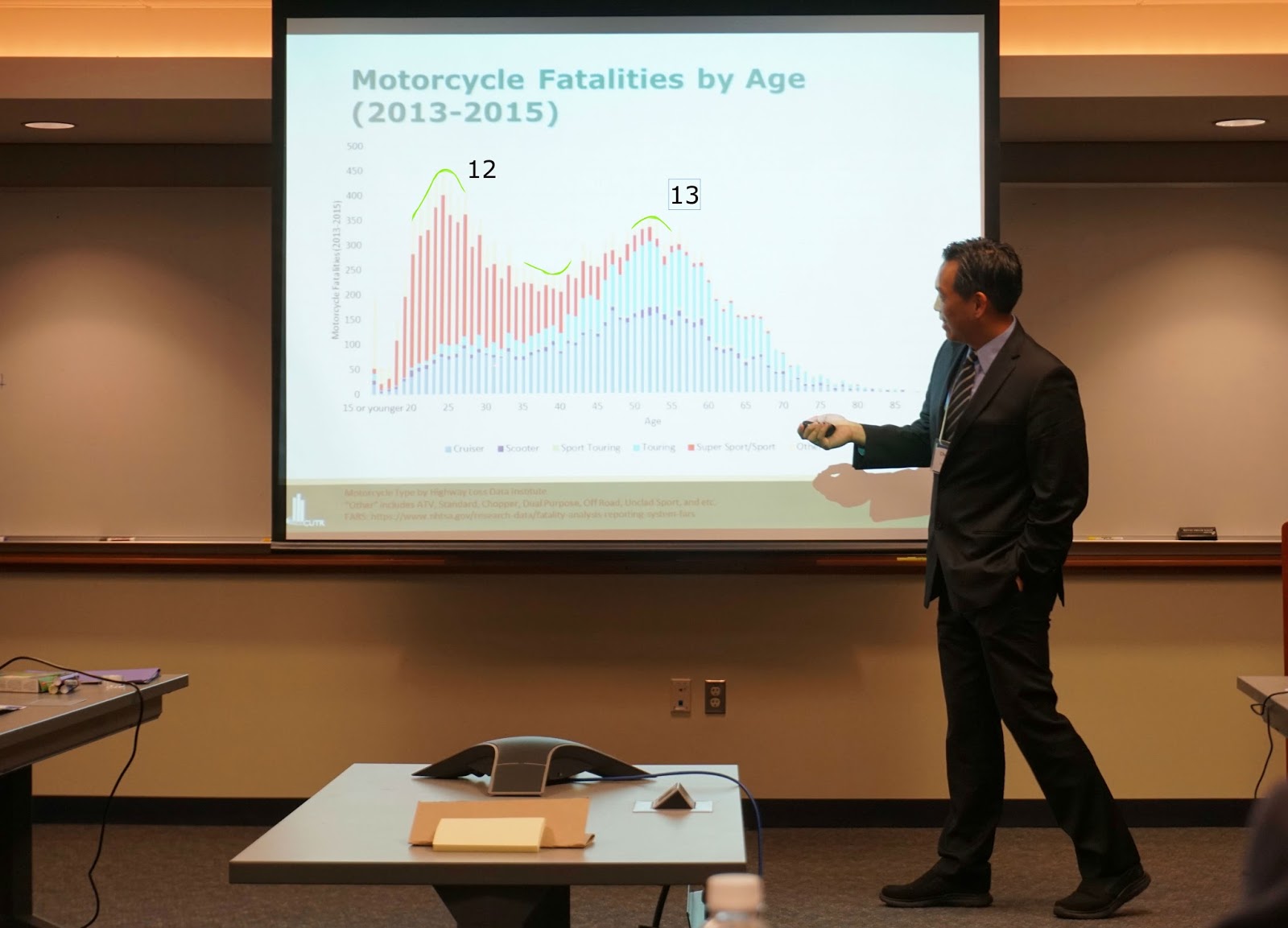
This graph compiles three years of fatalities, from FARS
data for 2013/’14/’15, broken down by motorcycle type. Sorry, but the exposure
on this photo barely captures the ‘Other’ category of motorcycles, which
includes everything from Naked/Standard to Dual Sport to MX bikes ridden on the
street. I hand-drew lines capturing the other data at peaks and troughs.
12–Everything their moms told them about motorcycles was
true
That huge red bulge indicates the scale of carnage, when it
comes to twenty-somethings on crotch rockets. The single most dangerous age
appears to be 24; that cohort racked up around 450 fatalities. That’s a lot,
but it’s even more striking when you realize the sport bike market is in the
toilet and the whole U.S. motorcycle industry currently bemoans the lack of
20-somethings shopping on dealer floors.
13–One way to avoid running out of money in retirement
The second big bulge is comprised of riders in their 50s to
early 60s, on cruisers and touring bikes. 52 year-olds topped off at about 360
deaths. The tailing-off of the red zone probably indicates that by the time you
hit 60, you’re not riding sport bikes any more–although it could also mean that
if you still ride sport bikes at that age, you’re more skilled and/or careful.
The bulge in deaths of middle-aged riders wouldn’t even be
noticeable except for one thing: the corresponding dip in fatalities amongst
thirty-somethings. Only about 260 people in the cohort of 37 year-olds died in
motorcycle crashes. It’s easy to conclude that by the time riders hit their
50s, they’re 40% more likely to kill themselves than they were 20 years
earlier. But I’m pretty sure that’s not true. There are a number of factors
that could skew deaths by riders in their mid-30s lower. That’s a prime age to
be married with children, which is a time of life that many people stop riding.
My suspicion is that this graph would really benefit from
some additional information, looking at VMT by each cohort. I’m pretty sure
that the first bulge would seem even more significant, while the second would
seem less so. What I want to know, before concluding that “the problem is all
these old riders” is, what is the number of miles traveled per fatality?
![]() |
| "Will Monsieur be dying alone tonight?" Asked the Maitre d'Hotel. |
Last but not least, this graph shows the ratio of
single-vehicle crashes in blue, compared to crashes involving other moving
vehicles (red). Each bar represents a year, between 1981-2015.
Not surprisingly, the ratio is remarkably constant. Between
40% and 45% of fatal crashes are single-vehicle crashes. You might just be able
to see the arrival of the first real race-rep supersports bikes on this graph,
in the form of a few years of rising single-vehicle fatalities in the late ’80s.
14–Hit me up. Or not.
The consistency of this graph makes the five-year slope from
2011-’15 look significant. For five straight years, the share of fatalities
involving another vehicle increased. Is this the ‘distracted driver’ effect?
That wouldn’t surprise me.
One way to change the single:multiple-vehicle ratio that
much, would be to add about 200 fatalities to the multiple-vehicle tally. An
extra 200 fatal crashes attributed to distracted driving, would mean a significant
share of responsibility for the “rising death rate among motorcyclists” was
actually car drivers’ fault.
In conclusion...
There was one moment at the MAC meeting when someone looked
at the period in the mid-’90s when motorcycle fatalities were half what they
are today, and said, “So you see, we can cut motorcycle fatalities in half,
because we’ve done it before,” and pointed to that area I labeled '6' above. That’s not a
solution the motorcycle industry wants to endorse, because it was a period of
dreadful motorcycle sales.
![]() |
| 15–Going back to what worked in the mid-'90s is not a safety solution the U.S. motorcycle industry can endorse. |
By contrast and unsurprisingly, the longer you ride without
killing yourself, the less likely you are to kill yourself riding. Is there a
limit to that observation? Of course; at some point, as we age, the time comes
to hang up the helmet. But an analysis of current FARS data, etc., without
information about VMT by those ‘danger-to-themselves’ fifty-somethings, must be
seen as speculation. I’m old, so I’m a selective filter for old friends; I
admit that, but I’m also certain that the people I know who rack up the most
yearly mileage are in that 50+ age bracket.
What the motorcycle industry needs is some way to bring in
noobs without exposing them to unnecessary risk. That’s a topic for a different
post.
If you've read this far, you must feel that you got something out of this long post. I spent hundreds of dollars traveling to Washington, and writing it took a significant amount of time and brain power. Want to throw a little something my way? I've never asked for a donation (and don't even have a means to accept one on this site) but if you want to reward me, buy this book. It's cheap and funny, and makes a terrific gift for any motorcyclist.
Note that the most recent NHTSA Fatality Analysis Reporting
System (FARS) data suggests that in 2016 there were 5,286 motorcycle fatalities
(out of 37,461 total) but that in some of these graphs, Dr. Lee used numbers
provided by the Insurance Institute for Highway Safety, so they don’t
necessarily add up exactly correctly. Any differences are statistically trivial,
both databases appear to show the same trends.
Labels:
Backmarker,
Monday Morning Crew Chief,
Strategy
Wednesday, July 26, 2017
"Ahm 'ere." Guy Martin gets out alive
I see that MCN's reporting Guy Martin's retirement. Guy's own Facebook page (Thanks for the tip, Steve!) suggests that outright 'retirement' is a bit strong, but I knew he was done at the TT even before he officially withdrew from this year's Senior.
Martin's been a pretty stalwart guy over the years, and he's bounced back from some scary crashes. But he was visibly shaken, even hours after found a false neutral and crashed his Honda at about 140 miles per hour, at Doran's Bend in this year's Superbike race.
I watched this interview and knew immediately: Guy's done.
That onboard video was also a PR nightmare for Honda. The company was already reeling from their 'A' rider's -- John McGuinness'-- similar crash and serious injury at the NW200.
The CBR1000RR SP's struggled in World Superbike and here in MotoAmerica (though Honda riders have fared somewhat better in BSB). Honda had high hopes for McGuinness at the TT, and would have used a win there to argue that the machine was, at least, a contender on real roads.
Serious TT fans questioned Honda's choice of Guy as McPint's teammate, because Guy's had relatively lackluster results on the Island in recent years (and has never won a TT). But the choice made sense from a marketing perspective because Guy's still a favorite with the punters, and a natural on TV.
Instead the bike -- which has a newfangled 'autoblip' feature -- was the culprit in two very high profile and well-documented crashes. I would not be surprised to see a chaste Honda presence on the Island next year.
That would be bad news for the TT organizers, but I'm sure they breathed a sigh of relief after the Senior, anyway, once they were certain Ian Hutchinson was going to survive a horrific crash that put a brutal end to what might've been a fairy tale ending to the fortnight.
The Hutchy story goes back to 2010. That year, he won five(!!!!!) TT races. Late in the summer-long afterglow, he lined up for a BSB Supersport support class race at Silverstone -- a modern circuit that should have been safe by comparison. But he crashed and was hit by two other riders, sustaining so much damage to his left leg that an amputation seemed inevitable. Five years and 30 operations later, he returned to the TT, won again and kept winning. Well 'ard, as they say over there.
That comeback story makes him even more popular on the Island than Guy is. He won the Superbike and Superstock races earlier in the week and if he could've ended the Fortnight by winning the Senior it would've been a feel-good story. But he crashed in the very fast 27th Milestone section -- severely, severely damaging the same leg.
Instead, surgeons had no choice but to completely remove his left ankle, and with several inches of bone MIA, he faces an excruciating recovery. I'd say, Hutchy's done, but I'm afraid he'll prove me wrong.
In a very slightly different universe, fan favorite Guy Martin would've been killed at Doran's and, a few days later, Hutchy -- arguably the TT's biggest star -- would've offed himself on the Mountain. Honestly, I don't think the event would have survived the press coverage. Or the soul-searching.
Martin's been a pretty stalwart guy over the years, and he's bounced back from some scary crashes. But he was visibly shaken, even hours after found a false neutral and crashed his Honda at about 140 miles per hour, at Doran's Bend in this year's Superbike race.
I watched this interview and knew immediately: Guy's done.
That onboard video was also a PR nightmare for Honda. The company was already reeling from their 'A' rider's -- John McGuinness'-- similar crash and serious injury at the NW200.
The CBR1000RR SP's struggled in World Superbike and here in MotoAmerica (though Honda riders have fared somewhat better in BSB). Honda had high hopes for McGuinness at the TT, and would have used a win there to argue that the machine was, at least, a contender on real roads.
Serious TT fans questioned Honda's choice of Guy as McPint's teammate, because Guy's had relatively lackluster results on the Island in recent years (and has never won a TT). But the choice made sense from a marketing perspective because Guy's still a favorite with the punters, and a natural on TV.
Instead the bike -- which has a newfangled 'autoblip' feature -- was the culprit in two very high profile and well-documented crashes. I would not be surprised to see a chaste Honda presence on the Island next year.
That would be bad news for the TT organizers, but I'm sure they breathed a sigh of relief after the Senior, anyway, once they were certain Ian Hutchinson was going to survive a horrific crash that put a brutal end to what might've been a fairy tale ending to the fortnight.
That comeback story makes him even more popular on the Island than Guy is. He won the Superbike and Superstock races earlier in the week and if he could've ended the Fortnight by winning the Senior it would've been a feel-good story. But he crashed in the very fast 27th Milestone section -- severely, severely damaging the same leg.
Instead, surgeons had no choice but to completely remove his left ankle, and with several inches of bone MIA, he faces an excruciating recovery. I'd say, Hutchy's done, but I'm afraid he'll prove me wrong.
In a very slightly different universe, fan favorite Guy Martin would've been killed at Doran's and, a few days later, Hutchy -- arguably the TT's biggest star -- would've offed himself on the Mountain. Honestly, I don't think the event would have survived the press coverage. Or the soul-searching.
Thursday, April 13, 2017
I got that all wrong
My beef with the way marijuana's treated as a banned substance in sports doesn't mean I think racing while stoned is OK. I don't.
The problem is that almost all available tests for the presence of cannabinoids return positive results long after the effect of using marijuana has passed. In America in 2017, as far as rules-makers are concerned, pot should be treated like alcohol. The goal should be to ensure riders aren't under the influence.
A test that bans a rider for using pot days before racing doesn't improve safety, it's just out of date moralizing.
I apologize for the error-riddled (but stimulating) opinion piece I wrote and posted earlier today, inspired by Dalton Gauthier's ban, which came after he tested positive for marijuana use after the Charlotte half-mile.
The problem is that almost all available tests for the presence of cannabinoids return positive results long after the effect of using marijuana has passed. In America in 2017, as far as rules-makers are concerned, pot should be treated like alcohol. The goal should be to ensure riders aren't under the influence.
A test that bans a rider for using pot days before racing doesn't improve safety, it's just out of date moralizing.
I apologize for the error-riddled (but stimulating) opinion piece I wrote and posted earlier today, inspired by Dalton Gauthier's ban, which came after he tested positive for marijuana use after the Charlotte half-mile.
I wrote the original version of this post as if AMA Pro Racing/American Flat Track used the World Anti-Doping Agency's (WADA's) banned substance list. That would be the case if Gauthier'd been a Supercross rider, but AFT rules are, as Al Ludington graciously pointed out, based on Nascar's substance abuse rules.
I’ve written before about the flaws in borrowing, wholesale,
a banned-substances list designed for sports like track and field or
weightlifting. Some day I'll peruse the AFT banned list in detail, but the larger point of my initial post still stands: While tests for alcohol measure blood alcohol and correlate with impairment, most marijuana tests currently look for metabolites and can yield a positive result long after the effects of using the drug have passed.
More and more Americans in all sports are being tripped up by
the inclusion of pot on banned substance lists. After all, recreational marijuana is
legal in several states, and most states offer some kind of legal dispensation
for pot use with (ahem) a doctor’s prescription. Even solidly conservative
states like Missouri, where I live, are softening their stances on pot use;
Kansas City recently voted to decriminalize possession of small quantities of
pot for personal use.
I don’t know whether Dalton Gauthier was actually racing
under the influence at Charlotte (in which case a ban’s justified) or whether a
random test merely detected use in the recent past, or during post-event celebrations.
Regardless, AMA Pro/AFT, MotoAmerica and other sanctioning
bodies would be well advised to acknowledge the relatively harmless reality of
marijuana use and to specify that cannabinoid drugs are banned in competition. AFT rules specify that alcohol must not be consumed for at least 12 hours before competition. A similar rule would be fair where pot's concerned. Merely using marijuana in the days or weeks leading to a competition, which probably would yield a positive test and result in a ban, puts us behind the times.
PS... For what it's worth, when I make a big mistake like that, I dock my entire salary for the day.
Friday, March 17, 2017
The first TTwins race in ages
I watched the first AFT race of the season with extra interest, since it was also the first TT or short track race under the new 'all twins, all the time' rules for the Expert class.
I should say that I watched it on FansChoice, not from the 'stands. There were some signal dropouts, and resolution issues but on balance I don't feel the quality of the coverage detracted from my experience.
Was that a Chris Carr track? Here's why I'm not going to hold it against him: I am pretty sure that the Speedway and AMA Pro ordered him to lay out a conservative TT track, in order to minimize the risk of a serious incident in the first 'return of the twins' race. (Memories of last year/California are still too fresh.) I understand that concern but maybe the erstwhile Prince of Peoria was a little too cautious. I read a few fan comments on Facebook to the effect of, "I thought there was supposed to be a jump". I don't think the racers were too keen it, either, although an Indian 1-2 finish in the Expert Main is an OK outcome from a marketing perspective.
I wondered whether, given the layout, the Experts were slower on twins than they would have been on singles. My first instinct was to think they would've gone faster on the old bikes, but since there's never been a previous race on this track, it was hard to quantify that feeling.
Still, I tried.
The top ten Expert finishers had fastest laps ranging from Mees' 29.7 to Shoemaker's 30.7. The average of the top ten finishers' fastest laps worked out to a hair under 30.3 seconds.
In the Pro class, the average of the top ten finishers' fastest laps worked out to a little under 30.7, for a difference of 0.4 seconds.
That does not sound like a big difference, but when you compare it to last years' singles-vs-singles Expert-vs-Pro times on short tracks and TTs, it suggests that the Experts were measurably but imperceptibly faster on twins.
I think it's pretty safe to say that we'll be able to see the difference in Peoria.
Shout out to Ferran Cardus, of Spain, for a hard-fought top ten result in the Pro final! One bright spot for Cardus' mentor, Brad Baker, who had an unlucky night for himself. Baker posted that he hoped he hadn't concussed himself -- I'm not sure if it's possible to be knocked out cold and wake up wondering how you got there and not be concussed too, but I believe AMA Pro Racing instituted baseline testing this year, for the purposes of determining when/if it's safe to put racers back on track after they've 'rung their bell'.
I should say that I watched it on FansChoice, not from the 'stands. There were some signal dropouts, and resolution issues but on balance I don't feel the quality of the coverage detracted from my experience.
Was that a Chris Carr track? Here's why I'm not going to hold it against him: I am pretty sure that the Speedway and AMA Pro ordered him to lay out a conservative TT track, in order to minimize the risk of a serious incident in the first 'return of the twins' race. (Memories of last year/California are still too fresh.) I understand that concern but maybe the erstwhile Prince of Peoria was a little too cautious. I read a few fan comments on Facebook to the effect of, "I thought there was supposed to be a jump". I don't think the racers were too keen it, either, although an Indian 1-2 finish in the Expert Main is an OK outcome from a marketing perspective.
I wondered whether, given the layout, the Experts were slower on twins than they would have been on singles. My first instinct was to think they would've gone faster on the old bikes, but since there's never been a previous race on this track, it was hard to quantify that feeling.
Still, I tried.
The top ten Expert finishers had fastest laps ranging from Mees' 29.7 to Shoemaker's 30.7. The average of the top ten finishers' fastest laps worked out to a hair under 30.3 seconds.
In the Pro class, the average of the top ten finishers' fastest laps worked out to a little under 30.7, for a difference of 0.4 seconds.
That does not sound like a big difference, but when you compare it to last years' singles-vs-singles Expert-vs-Pro times on short tracks and TTs, it suggests that the Experts were measurably but imperceptibly faster on twins.
I think it's pretty safe to say that we'll be able to see the difference in Peoria.
Shout out to Ferran Cardus, of Spain, for a hard-fought top ten result in the Pro final! One bright spot for Cardus' mentor, Brad Baker, who had an unlucky night for himself. Baker posted that he hoped he hadn't concussed himself -- I'm not sure if it's possible to be knocked out cold and wake up wondering how you got there and not be concussed too, but I believe AMA Pro Racing instituted baseline testing this year, for the purposes of determining when/if it's safe to put racers back on track after they've 'rung their bell'.
Wednesday, March 16, 2016
AMA: OK, you've made your point. Let Eslick ride.
I was just going to let this story lie, but this morning I got a phone call from a guy whose opinion I respect, in the moto-world. He agreed with me that Eslick—while he is guilty of stupidity—isn't any more guilty than countless other racers have been, in Bike Weeks past. To say nothing of the shenanigans we've seen over the years at Siebken's, on Road America weekends.
My friend pointed out that the woman Eslick was alleged to have pushed to the ground declined to press charges; if Danny hadn't run off, the whole thing would've ended with an apology to her and warning to him, right there on Main Street.
My friend wondered whether someone wanted Eslick suspended just to create some/any media interest in the race. "It's not as if he's Anthony Gobert," my friend said, "who was given chance after chance." That may have been a little conspiracy-theorist, but the AMA itself said that it was suspending Eslick because, "...there is zero tolerance for behavior that is detrimental to the promotion of motorcycling."
Here's a news flash, AMA: The 200's been held in a media vacuum for the last few years. The only reason anyone noticed Eslick's run in with the law was because you publicized it.
That's what the AMA should do now, too. Put him on probation.
The terms of his probation include submitting to regular testing for drug and alcohol use. If he tests positive, he'll presumably be subject to re-arrest and imprisonment.
That seems reasonable enough, and will almost certainly do Danny some good. But there's a catch... According to Eslick's lawyer (as reported in the Daytona News-Journal here)...
But this is another example of a motorcycle racing governing body cherry-picking when it will or won't abide by laws that may or may not actually govern that organization.
So here's my message to the AMA and MotoAmerica: you have your own options, when it comes to putting Danny on probation; there's no reason at all why you have to wait for Florida's Circuit Court to figure out how it will administer its probation.
Let Danny ride, starting now. Make regular drug and alcohol testing a condition of his return. Be firm, reasonable, and transparent. Don't take away his livelihood for a misdemeanor.
My friend pointed out that the woman Eslick was alleged to have pushed to the ground declined to press charges; if Danny hadn't run off, the whole thing would've ended with an apology to her and warning to him, right there on Main Street.
My friend wondered whether someone wanted Eslick suspended just to create some/any media interest in the race. "It's not as if he's Anthony Gobert," my friend said, "who was given chance after chance." That may have been a little conspiracy-theorist, but the AMA itself said that it was suspending Eslick because, "...there is zero tolerance for behavior that is detrimental to the promotion of motorcycling."
Here's a news flash, AMA: The 200's been held in a media vacuum for the last few years. The only reason anyone noticed Eslick's run in with the law was because you publicized it.
That's what the AMA should do now, too. Put him on probation.
The terms of his probation include submitting to regular testing for drug and alcohol use. If he tests positive, he'll presumably be subject to re-arrest and imprisonment.
That seems reasonable enough, and will almost certainly do Danny some good. But there's a catch... According to Eslick's lawyer (as reported in the Daytona News-Journal here)...
The court was willing to accept the proposed plea resolution which is a misdemeanor charge but unfortunately the court cannot control the Department of Corrections with regard to their ability to accept it in a mail in or phone in basis.
So for now, until prosecutors file misdemeanor charge papers and determine whether or not a probation service provider will accept a mail-in or phone-in appearance, Eslick, of Broken Arrow, Oklahoma, remained suspended by the American Motorcycle Association and cannot compete in motorcycle events.What that means is, Danny's in a sort of legal limbo. The jurisdiction in which he was charged isn't sure how to make him subject to the terms of his probation where he lives (much less, as he travels around the U.S. to race) and apparently that's why the AMA says he must remain suspended.
But this is another example of a motorcycle racing governing body cherry-picking when it will or won't abide by laws that may or may not actually govern that organization.
So here's my message to the AMA and MotoAmerica: you have your own options, when it comes to putting Danny on probation; there's no reason at all why you have to wait for Florida's Circuit Court to figure out how it will administer its probation.
Let Danny ride, starting now. Make regular drug and alcohol testing a condition of his return. Be firm, reasonable, and transparent. Don't take away his livelihood for a misdemeanor.
Sunday, March 13, 2016
Eslick. Not so slick. But I still have questions...
The American Sportbike Racing Association event is a standalone premier American road race. While the 2016 Daytona 200 is not part of the AMA-sanctioned professional road racing series in which riders earn points toward an AMA National No. 1 plate, it remains an important part of America's motorcycle racing heritage. — AMA Press Release announcing an AMA sanction for the Daytona 200
The American Motorcyclist Association and the American Sportbike Racing Association, in consultation with Daytona International Speedway, have suspended professional motorcycle racer Daniel C. Eslick of Broken Arrow, Okla., from the Daytona 200 for actions deemed to be detrimental to the sport... The AMA has extended Eslick's suspension to all AMA-sanctioned activity.— AMA Press Release announcing Danny Eslick's suspension prior to the Daytona 200
A note from the Dept. of Unanswered Questions...
A few weeks back, I got a Press Release from the AMA, touting the fact that the AMA would be sanctioning the Daytona 200.
You already know that for the last couple of years, the 200's been an ASRA event, because MotoAmerica dropped Daytona from the U.S.' premiere road racing series.
The first thing I thought, last month, upon reading the AMA's breathless release saying how great it was that they'd be sanctioning the 200 again was, Wait a minute... didn't the AMA always sanction ASRA events? To confirm that, I logged on to the Wayback Machine Internet Archive and found an ASRA home page from 2014. Sure enough, there was the AMA logo.
Remember that DMG, which took over AMA Pro Racing, is basically a subsidiary of the Speedway (or at least controlled by the Speedway's owners). Not that long ago, DMG was reviled by the stakeholders of the new (AMA-sanctioned) MotoAmerica series. I doubt that many MotoAmerica riders and teams miss the Speedway, so the AMA's love-struck description of the storied 200's history felt odd. But, I just filed it away under It Sure Didn't Take Long For The AMA And The Speedway To Kiss And Make Up.
I thought no more of that until Danny Eslick was arrested in Daytona, then was banned from competition. Actually, let me amend that... Something bugged me about Eslick's ban, but I couldn't put my finger on it until after the race.
It wasn't, plus-or-minus, the issue of whether Eslick should've been denied entry into the 200. I don't really have strong feelings either way. I've met him but don't know him. I do know enough about Bike Week in particular and cops in general to know that there's not necessarily a relationship between real events and charges laid. (Though in the limited defense of the Daytona PD, I imagine Eslick did something stupid enough to warrant a night in jail.)
![]() |
| FWIW, Eslick looks much nicer than almost anyone else on the Daytona mug shots web site. |
Whatever really happened, I doubt that Eslick's transgression was any stupider than countless other racers' shenanigans during Bike Weeks past. Let's face it: motorcycle racing is not exactly a selective filter for good judgement. Quite the opposite.
What bothered me about the sequence of press releases was...
- Isn't the 200 an ASRA event? Why didn't ASRA issue Eslick's ban? There's not even a copy of the AMA's press release on the ASRA web site.
- At this point, I wonder whether ASRA, the event organizer, even thought to ban Eslick. Or did that idea originate with the AMA, or the Speedway?
- Why would his ban summarily extend to the MotoAmerica series, which has never had anything to do with the 200? Was that MotoAmerica's idea? Or the AMA's? And if it was the AMA's, will MotoAmerica henceforth be letting the AMA decide who rides and who doesn't?
- What other motorcycle blog even uses words like 'henceforth'? Heretofore, I don't think I've seen that word come up.
To be clear: I don't have strong feelings on Eslick's suspension per se. If it'd been up to me I'd've let him ride provisionally, while withholding prize money until he faced the charges. I'd reserve the right to rescind points, subject to a full determination of the facts.
Should he be on probation? Hell yes. Definitely.
Is an outright ban reasonable? Maybe.
Is this another moment when the administration of American professional motorcycle racing desperately needs more transparency? Yes. Most of all, yes.
*Note to ASRA: If the Eslick sanction originated within your organization, feel free to contact me. I'll happily attach a statement to this post.
Subscribe to:
Posts (Atom)