Wednesday, April 20, 2011

Ten entrepreneurs who made things happen

It’s hard to make a good motorcycle. Maybe it’s even harder to make money making motorcycles – but if it wasn’t possible to do so, we’d have nothing to ride! Over the next couple of weeks, I'll post short bios of ten of the most influential motorcycle entrepreneurs.

At #10, “Big” Bill France – promoted the Daytona 200
France is best known as the father of NASCAR and the builder of Daytona International Speedway. The city of Daytona Beach convinced the AMA to hold the 200-mile national championship race there in 1937. After a few lackluster years, it seemed Daytona would lose the race, until France (a mechanic and beach racer - in cars) was convinced to become the promoter. He continued to promote the race until, realizing that it could not continue on the beach, he built the speedway. He opened his track in 1959 and the AMA saw the light and moved the race there two years later. Under France’s control, the race became an international sensation. Over the next ten or 15 years, it became the only American road race with really 'international' stature; Hailwood, Agostini and a host of GP stars often came over to race there. Bill France died in the early '90s, and his son, Bill Jr., took control of the Speedway
Bill France, with his son Bill France Jr., who was an avid motorcycle racer in his younger days.
A friend of mine recently told me a story about going to meet Bill France Jr. shortly after he took over the family business. By that time NASCAR was already a big business, but the most prominent racing photo on the office walls was a shot of Bill Jr. racing a Bultaco short tracker. Over the last few years, many in the motorcycle racing community have been dismayed by some of Daytona Motorsports Group's handling of AMA Pro Racing, and some have wondered if the current head of the family dynasty has lost his love of motorcycles. I think it's more likely that, since NASCAR is so much more important to the dynasty than is motorcycle racing, he simply has to delegate.

Tuesday, April 19, 2011

Notes from the blue groove - Du Quoin

I just got back from Du Quoin, where AMA Pro Racing held the first indoor flat track race in about five years. The whole journey will take a while to write up; suffice to say that I started and ended the trip from Kansas City on my corroded Triumph Bonneville, but that I arrived and left Du Quoin in a rental car. Use your imagination...

Nope, it was way worse. Oh well, all's forgiven now that the Triumph's running again.

I thought battery life could be a problem on those electric bikes...
Before Du Quoin, I chatted with a few flat track lifers who told me that on those really short tracks (laps of less than 12 seconds!) anything could happen. I can't remember who won last time they raced there, but I think it was a guy who'd never won a national before, and hasn't since.

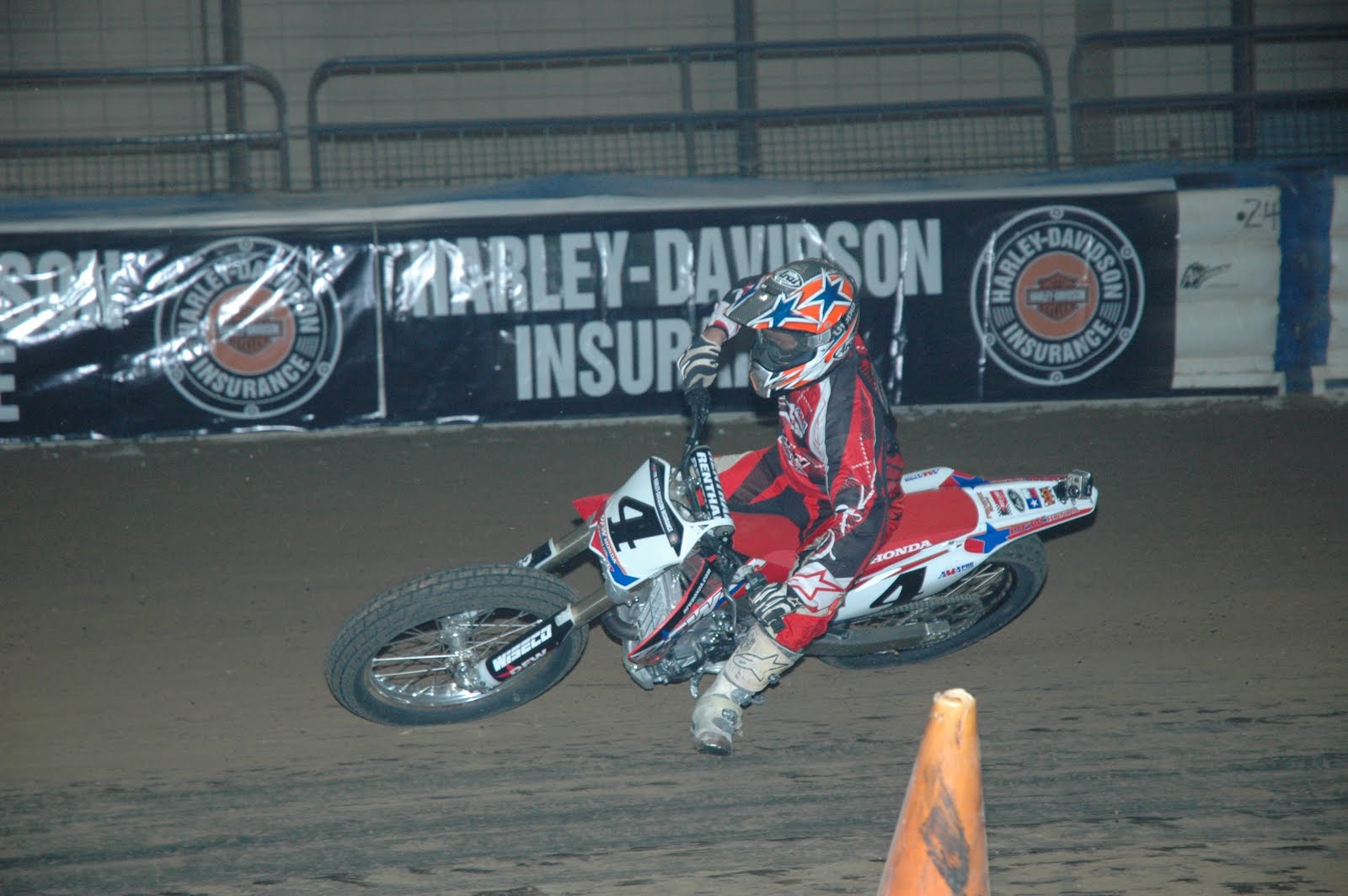
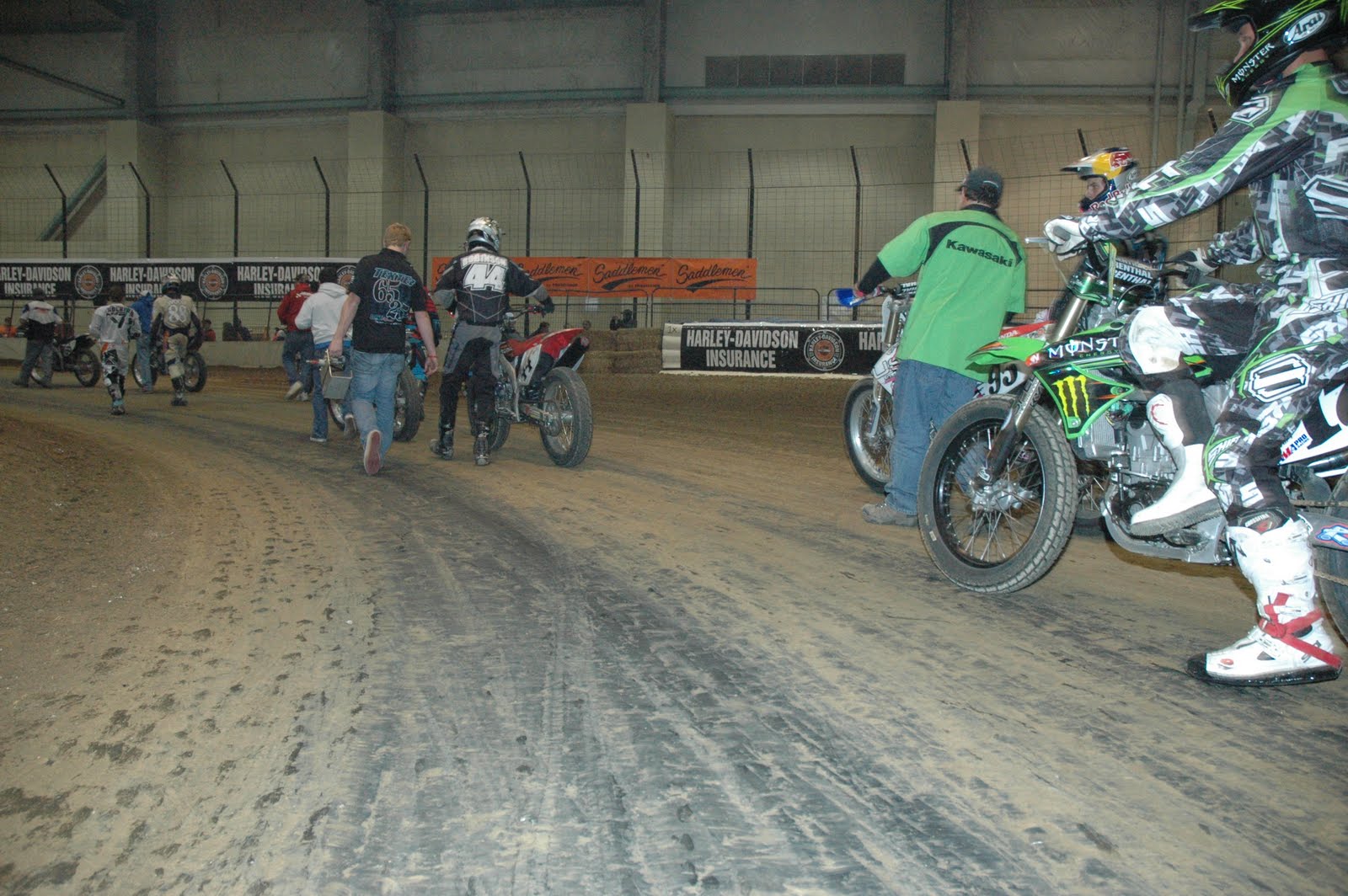
Walking into the arena itself was a little underwhelming. It's no Astrodome, if you're talking indoor nationals. It's not even a Cow Palace. There's about 2,500 seats along one side, and the bikes were packed into a space about 30 feet wide between turns 2 & 3,  and the outside wall of the arena.

The surface in the arena started out fantastic. Walking across it in my sneakers, it was so tacky that that my feet actually made little sucking sounds with each step. Chris Carr told me, "It's great! It's the 'Mile' dirt but it's indoors so it won't dry out."

AMA Pro worked the surface at every opportunity in practice and qualifying, when the riders - as much as possible on such a tiny track - tried to stay out of each others' way and put in a clean lap. 55 Experts showed up (54 guys and Nichole Cheza.) There were more Experts than Pro class riders. With only 48 slots up for grabs in the heats, that meant several guys would be sent packing after - get this - a total of less than two minutes of practice and qualifying. You had to come out of the pen with your hair on fire from the first moment.

Early in the night, grip was not an issue.
In those first sessions, while it was the tackiest imaginable clay cushion, the grip and lean angles were awesome. The handful of fans who showed up that early saw some amazing riding. Sammy Halbert told me after the first session that he thought he had too much grip, and that his bike was hooking up and running him wide. As frantic as it looked, riders had to be as precise as possible. There could be 10 guys in the same tenth of a second, so there was no such thing as a tiny error. And there was a mark to hit every second or two, so there wasn't much time to gather things up if you missed one. This was racing reduced to its essence, with many riders electing to start in second gear, and not shift even once all race. Picture speedway, but with the entire night's field on the track at once.

As the stands filled up (not totally, but I'm guessing there were at least 1,500 people for the show) AMA Pro let the groove develop; fans, understandably, would rather watch racing than the tractor. Everyone I talked to before the heats had expected a groove, but most of them thought it would have enough grip that the winning tactic would be to nail your start and then pole-putt around the inside.

Instead the groove got slick, and the fast line was at the edge of the cushion. Carr and Coolbeth, in particular, dominated their respective heats. Kenny Tolbert must've forgotten to tell Chris that he's an old, slow guy on the verge of retirement. He looked about 19 out there.
Textbook style, just the way they teach it at American Supercamp where he's the most regular guest instructor. Carr ran away from the field in his heat race, and the Dash For Cash was a preview of the Main. No one at Du Quoin had anything for either Carr or Coolbeth.

With the inside line that slick - it was slippery even to walk on it - there was not much chance to "high-low" the guy in front of you. The door seemed to be open, but there were very few guys who could hook up on it at all. It got pretty physical out there, although the Experts might've been slightly chastened by watching a Pro crashfest that included a couple of real pile-ups.

At the end of the night, while anything might've happened and we could've seen an unexpected winner - one of my tipsters picked Jimmy Wood - it was Coolbeth who took advantage of Carr's one bobble in duel between the two smoothest and fastest guys out there. Jake Johnson was the best of the rest, so the three single-digit guys on the podium were the same guys who've accounted for something like 200 Grand National wins between themselves.
One insider tipped Chad Cose (49) as a dark horse going into the event. He spends the winter riding the Barn Burner series in NorCal, and raced Cow Palace before Du Quoin. Indeed, he led Coolbeth early in their heat, then on the next lap...

...this happened. Coolbeth was not to be denied, all night.
 As everyone packed up and left, we walked out into a night that had grown almost breathtakingly cold. It sure as hell didn't feel like an April evening in a place that's nearly in Tennessee. It was lucky as hell that the event was indoors, or the audience would've been frozen by the last race.

By the time the Main  rolled around, the groove was so slippery I could tell it was useless to race on just by walking across it.
 I'd love to write a bit more for you, but I'm on about three deadlines Gotta' go!

Friday, April 15, 2011

Sympathy for the devil

I can't believe that I'm siding with Danny Pedrosa on anything, but I think the proposed combined-bike-and-rider weight minimum in MotoGP is a bad idea, for a number of reasons.

It's going to be hard to administer. Will the minimum weight be checked post-race, for both bike and rider? You'll see riders sucking back Monster Big Gulps on the way to tech in hopes of getting back up to weight. Or will riders have some official weigh-in at some prescribed point in the season or race weekend? That's going to open up a whole stupid new area for gamesmanship.

The goal of the proposed rule is presumably to cut the advantage of very small/light riders. The thought is that their teams will have to ballast their bikes to level the playing field. But it won't work as well as people hope. Soon after the rule's put into play, you'll hear heavier riders complain that smaller riders' team have too much freedom locating ballast, and thus they're gaining an advantage in locating their c.g. And teams with light riders will still save money, since the marginal cost of shaving a kilo of weight from a MotoGP bike is, I'm sure, about $20,000.

Although it's true that bigger riders are harder on brakes and tires, and are a drag, aerodynamically - and thus presumably burn more fuel, anyone who's ridden a motorcycle at the limit (or even at his/her own limits) knows that it's tiring work. At comparable fitness levels, a bigger rider has some compensatory advantages in strength and in his ability to position his weight where it improves cornering or acceleration.
Although larger riders gripe about Pedrosa's fuel mileage, Dani argues that his small size can sometimes be a disadvantage. Here, for example, he struggles to keep the Honda down.
 I admit there are limits to this, which is why it's very rare to see a top-level motorcycle racer built like a linebacker, and lots of people have, um, weighed in on this debate by saying "It's really about the 21-liter fuel capacity rule; we heavier guys have to lean our engines out too much." Maybe they have a point, but I like the fuel capacity rule. It's a useful fig leaf when our sport comes under the eye of environmentalists.

I could go on about this, but I have to get on my bike... I'm going to try to ride my corroded Triumph Bonneville to Du Quoin for the next AMA flat track event. If I make it that far, you'll read about it here. So I'll just close with my final argument, which is simple and has really nothing to do with the technical implications of the proposed rule. It's simply this: there are only a handful of sports in which size isn't an advantage. An athlete of Dani Pedrosa's size has no chance of reaching the top level in any team sport, or athletics, swimming, rowing, or even tennis. Sure there are weight-class sports like weightlifting, wrestling, and boxing but there's not a world champion in those sports, is there? There's a about sixty of them and most are completely anonymous.

MotoGP, and motorcycle racing generally, is one of the only places where little guys (or for that matter girls) get to compete with everyone else on an approximately level playing field. The people who want to impose the combined bike-rider weight rule are arguing that that field slopes ever-so-slightly down when little guys like Pedrosa are competing. Since every other field he could possibly play on slopes up at about a 45-degree angle, I say let him have it.

Tuesday, April 12, 2011

Austin's Power!

Is it just me, or did the Austin MotoGP race go from tantalizing rumor to announcement in record time?

I read (courtesy of Indianapolis Motor Speedway) that Dorna's announced Colin Edwards' home GP effective 2013. This is great news for a few reasons.

I'm not sure how long Indy's destined to remain on the calendar; I think they've renewed their contract for the 2012 event but it's year-by-year. Here in the 'States, motorcycle racing fans and the motorcycle industry have been glad to have IMS' marketing and promotional muscle behind MotoGP in particular and motorcycle racing in general. But I suspect that there are quite a few purists in the FIM, Dorna, IRTA, etc., who chafe at the idea of an infield road course event, no matter how skillfully it's promoted.

Having lived in  Texas for a while, I can tell you that the "everything's bigger here" mentality can be insufferable, but it's a great attitude to have when promoting an event. Austin, in particular, has proven with the SXSW Festival that it doesn't have to be an event in which the stars are already famous here; they're perfectly happy to make their stars famous. Lots of bands broke into the big time after their star turn in Austin. Maybe it will be the same for MotoGP.

I have read that the event is financially supported (to an eight-figure tune) by the State of Texas. That's noteworthy in a state that is in the budget-cutting vanguard. But the key to state support is tourism. Texas has a great tourism promotion program, and when I worked on tourism accounts in my ad days I learned that foreign tourists are the holy grail for such departments. Most tourists come from within your own region, or from adjacent regions - but the most profitable tourists by far are the ones from afar. They stay longer and spend more per day.

Although Indianapolis means 'motorsport' to us here in the 'States, it's reputation in Europe is not that strong (and was not helped at all by either the first F1 car debacle or the weather at the first MotoGP event.) On the other hand, Texas is something people really 'get', all over the world. It's no accident that the Marlboro cowboy is used to promote that brand from Copenhagen to Capetown to Macau. Texas will be an easy sell.

I'm definitely not saying that Texas should necessarily replace Indy. As low-profile as MotoGP is, in the U.S./North America, this is still a huge market and we could easily justify three MotoGP races (and two or three SBK events -- Come on, Barber... lengthen your track, improve your paddock, and earn a World Championship event too; you've already got the facility to support it.)

Well, yee-haw.

Friday, April 8, 2011

Oops, was yesterday Thursday?

It's been one of those weeks. Actually, it's been one of those lives, but even by the standards of my life, it was one of those weeks, too. My apologies to the long-time readers who are used to checking in on Thursday and seeing new material. I really hope to get back on a regular schedule sometime soon. (Speaking of which, stay away from the babaganoush at 'Sahara,' the Libyan restaurant on 51st by UMKC in Kansas City, but I digress...)

What ever happened to Supermoto, eh?

I was at Indy a few months ago, and had dinner one night at a big table of guys who had all spent their lives racing motorcycles. Several of them had been early adopters in the Supermoto discipline, and the waxed on about the early days of the sport, when unknowns would bang bars with Nicky and Tommy Hayden, who were training in the off season, and of thrilling venues like Reno and Troy Lee's Long Beach event. Now, of course, there's not even a national championship.

I just filed that away until a few days ago, when I stumbled across this great YouTube clip of one of the ABC Television 'Superbikers' shows, from the 1980s. The race coverage is actually not that compelling, though that critique is made in light of what we're used to now, with more camera angles, on-board footage, etc. For all I know, this Superbikers event was shot on film. And the venue is not up to snuff.

But.


It's a compelling show. It recalls days when motorcycle racing was deemed worthy of putting in front of a huge audience. Bear in mind that given the fragmentation of media now, I'd be willing to bet you that more people watched 'Superbikers' then, than watched the last Daytona 500.

ABC, of course, totally 'got' the fact that its huge TV audience were by and large ignorant of motorcycles and motorcycle racing, so the Superbikers format - separate heat races for dirt trackers, motocrossers, and road racers; personality profiles - and then a final pitting the best of the best was expertly structured to provide viewers with just enough context to get them emotionally involved. (The format actually owed a lot to 'Superstars' a general-athletics show/contest conceived by, of all people, Olympic figure skater Dick Button.)

So as I sat talking with my friends and we replayed, in our minds, the rise and fall of Supermoto, we inevitably got back to the Superbikers days and lamented that Supermoto never succeeded in grabbing that mass audience, despite the superficial similarities. The current Supermoto racers in the group suggested a number of reasons for Supermoto's underwhelming public reception, ranging from a rising cost structure that thinned grids, to the fact that the public can't really relate to motocross-based bikes on the street because so few OEMs have gotten behind the concept with any real enthusiasm.

It was only when I watched this clip that the obvious hit me: What's compelling in the Superbikers format isn't the fact that it combines dirt and asphalt; what's compelling is that it brought the stars of Superbikes, Motocross, and Flat Track together on a (bumpy but generally) level playing field. It was fascinating because none of those guys had ever really practiced that format and it offered us a chance to see which among them was 'the best of the best' or at least who among them had the most raw adaptable talent and the greatest will to win on the day. The bikes and tires they used were not particularly suited to the task and with limited setup time it was clear there was no advantage to be found there, either.

By making that format a discipline in itself, it was doomed to failure. As soon as it was something you could practice or specialize in; as soon as it became possible to find a mechanical advantage, it lost the very hook that made it work.

Superbikers worked because it presented itself as a one-race national bragging-rights championship. It occurs to me that Pikes Peak has some of the same charm; it's so unlike anything else that you can't practice for it. Right now, the course is so unique that the record will likely go down this year, to a bike - the Ducati Multistrada - that is not even raced anywhere else. By next year, if the rumors I hear are true, the entire course will be paved. If you could ever clean it properly, an all-asphalt course would be a race for sport bikes, but I can't see that happening: there will always be issues of dust and rocks kicked up on a course shared with four wheelers. Their racing line involves putting two wheels off the inside on many turns; and besides, it's all too common to start on a dry course and end on a wet (or even snowy) one. But once Pikes Peak is all asphalt, I think the Multistrada crew would have their hands full with rivals on like a Triumph Speed Triple (or even a nimbler Street Triple.)
Pikes Peak is the opposite of a level playing field, but I think that it could be promoted in a way that gave it some of that Superbikers cachet. The race's 100th birthday is coming up (in five and a bit years) and I'd love to see that event packaged as a compelling TV show pitting the stars of Superbikes, 'real roads' racing, and what the hell, even MotoGP against select flat trackers and all-comers against each other... on 'real' - i.e. naked, proper bikes.

Last but not least...

While I'm on the subject of unique ways to leverage motorcycle racing and reach a wider audience, I note that TT star and all-round great, uh, guy - Guy Martin - has become a surprise TV star in the U.K.

Although he's a lunatic on a motorcycle, Guy's a lovable 'everyman' off the bike. Good looking in a Hugh-Jackman-as-'Wolverine'-but-not-as-intimidating kind of way, he's funny and very down to earth. Until recently, he was a famous TT racer in the summer and spent winters working as a heavy-truck mechanic, earning an hourly wage.

But he sunk (oh, wrong word) his TT winnings and appearance dosh into an old English canal-boat. They call them 'narrowboats' over there, because 150 years ago they were long and narrow, used to move goods through a network of canals that covers a good part of England.

Guy decided that he wanted to restore his narrowboat, but with this catch: he wanted to use only tools, materials, and techniques that were available when the boat was made. That idea caught the attention of a 'reality TV' producer at the BBC, and 'The Boat that Guy Built' has become an incredibly popular television show in the U.K. Some episodes, more than a quarter of all the TVs that are turned on in the U.K. are tuned to his show.

There are quite a few motorcycle racing fans that are dismayed because the show barely refers to Guy Martin's other job, although it is mentioned in every opening sequence if only to emphasize the difference between ripping through Kirkmichael at 180, and putting along a leaf-strewn canal somewhere in the British Midlands at 1.8 miles an hour.

The tone of the show is in sharp contrast to the feuding Teutels. Here's the trailer. Until later, Cheerio...


Oh wait! Don't forget to bid on my autographed helmet! The auction ends Sunday...

Monday, April 4, 2011

For sale: 40+ major championships! (Free helmet included)

About 15 years ago, I was at an American Supercamp taught by Chris Carr and Will Davis. I was wearing a white Arai helmet for the sessions, and on the spur of the moment I asked Carr and Davis to autograph my lid. One thing led to another, and over the years, when I encountered a famous racer who I liked, I asked them to sign it too. (So, despite many opportunities, I never got Phil Read or Mat Mladin to sign it, for example.) As the helmet got older and more covered with signatures, I stopped riding in it, and for the last few years I've only carried it around in a cheap helmet case when I have the presence of mind to think I might get another good autograph for it.


After a while, I thought "Some day I'll eBay this thing for a good cause." Well, that day has come, and I'm going to sell it to help defray the U.S. federal government's enormous debt. Yes, I'm going to give the money to the IRS. To learn more (and bid on it!) follow that tantalizing read more link below...

Stoner: "This commercial is lame"

Most high-level motorsport sponsors spend at least three times their sponsorship budget advertising and promoting the sponsorship. Yes, this means that Mars Inc. spends much more on cardboard cut-outs of Kyle Busch displaying packets of M&Ms at 7-11 stores, than they do on his #18 NASCAR.

It also means is that many racing teams actually get more exposure from sponsor advertising than they do at the track (a fact that helps to hedge against a season in which the sponsored driver or rider isn't battling for the lead in every race.)


Sometimes, this advertiser-controlled exposure pays huge dividends back to the team. Ducati, for example, could never afford to buy the exposure it got when Xerox decided to make its Ducati sponsorship a major theme in overall corporate advertising.

Unfortunately, that benefit won't accrue to the factory Honda effort when Repsol airs this commercial. The tagline might tell us they're inventing the future, but Repsol's ad agency is just recycling clichés. Yes, it's all in slow motion, even though none of the action requires slow motion for it to be fully grasped; that's how we know it's all cool. And they've managed to make even MotoGP, one of the world's most visually compelling spectacles, completely sterile.


What's Casey Stoner thinking at the 16-second mark in the spot, when he slaps his forehead? I'm guessing it's, "Mate, this spot is lame."

I was hoping to find a great counter-example to this spot on YouTube - Remember a few years back when, during SpeedTV coverage of AMA Superbike races, there was a great Dunlop tire ad that was made up of shots of racers using gestures and body language to tell their crew chiefs how their bikes were handling? It was a thing of beauty (all the more so because I am sure it was done on a tiny budget.) It worked because it got to a compelling underlying idea -- that top racers are more sensitive to some things, like tires, than we mortals -- and it implied that if Dunlop tires were built to their standards they'd more than meet ours. It was filmed at an actual race weekend, in all its chaotic glory. And the people in it weren't acting, they were just being their unselfconscious, real selves.

If any Backmarker readers happen to have that Dunlop spot -- or better yet were involved in its creation -- please contact me, eh?