Saturday, May 28, 2011

I should never have said, "Maybe it won't rain."


Springfield. It's a big deal, in Springfield (also the capital of Illinois, and home of Abe Lincoln, who is probably not the 'Abe' cited in the bottom image.)
It's been a hell of week for weather in the Midwest. Of course, there was the deadliest single tornado in decades in Joplin, and the following couple of days were seriously ominous in Kansas City, with tornado warning sirens going off for hours at a time.

Springfield's only a few hundred miles from KC, so it was with some trepidation that I checked the Springfield forecast last Wednesday, but it looked good for racing. As I packed my gear on Friday night I thought, Rain jacket? Nah...
Every kind of gear except rain gear.
That was mistake number one. You should always pack rain gear, so that it won't rain. At 0630 this morning, I collected photographer Phil Peterson and we headed east from Kansas City into unbroken heavy cloud cover. (Phil's never shot or even attended a flat track race but if you check out his portfolio, here, you'll understand why I'm eager to see the images he comes back with.) Phil mentioned that he'd checked the weather forecast just before going to bed and they'd changed the forecast to a 40% chance of rain. Still, we got all the way to the Illinois State Fairgrounds with just the finest smattering of droplets.

Then, as we were picking up credentials, I said, "Maybe it won't rain."

That was mistake number two. It started to rain. Then it started to pour. There was lightning. Toto, we're not in Hollywood any more. Oh, and then it hailed.

Nichole Cheza's team couldn't get their truck into the pits to remove their gear, so Nichole rode one of her bikes out to the road. Her dad(?) told her, "Try not to get it all muddy." Right.
Saturday's program - the Springfield TT - was canceled before it started, and rescheduled for Monday. With memories of recent tornados and flooding along the Mississippi in Illinois, the vibe wasn't, like, 'Let's go to the motel and watch TV,' as much as 'Let's get the heck out of here.'

The evacuation from the pit area of the multiuse stadium resembled the evacuation of Dunkirk (minus artillery and strafing runs, but you get the picture) with guys pulling trailers down from the parking lot to load all their gear creating gridlock for those trying to leave.

If anything it rained even harder later in the afternoon, and it remains to be seen what the Mile track will be like tomorrow.

So, I waited out the rain in a cafe downtown. To get online, I had to select a network. Judging from name of the top-listed network in this screen cap, there's at least one guy in Springfield who's less than enthused at the influx of Harleys...

Friday, May 27, 2011

The good news: Leno finally talks motorcycle racing on Tonight Show. The bad news: Leno's guest is Paris Hilton

Last summer, some friends at Yamaha asked me to pitch Jay Leno on the idea of Valentino Rossi as a guest for The Tonight Show. I've profiled Jay for a few magazines; I know he's a genuine gearhead, not some Hollywood twerp who bought a bike on his publicist's advice, because it would make him seem cool or macho. But, I also know that he's a bike guy, not really a racing guy.

Jay shut me down instantly when I suggested Rossi as a guest. He told me that The Tonight Show's producers knew from experience that racing doesn't hold the interest of mainstream American TV viewers. He cited one bad experience, which I think was Mario Andretti bombing on his show. And, he noted, "There's the accent thing." Apparently, Americans also don't like listening to guys with foreign accents. In fact, he'd learned over the decades that sports, period, didn't fly with Tonight Show viewers. "Maybe, if you can get the Superbowl-winning quarterback on the Monday after the game," Jay told me. "But even that..."
Leno mugs with Yamaha motorcycle division honcho Henio Arcangeli.
In the end, although Jay hosted the Yamaha MotoGP team at his garage, Rossi never showed. (He'd been injured by then, and had a great excuse.) After I'd told Jay it would be a small private party, Yamaha piled on about 150 guests. Jorge Lorenzo was a guest of the show, but not a guest on the show; he sat in the audience. If the camera panned across him during the broadcast, no special notice was taken of the MotoGP World Champion-in-waiting. Yamaha wanted to make Jay their guest at the Laguna Seca MotoGP round, but he had a scheduling conflict. (Jay and few garage employees later attended the Indy round.)

But now, World Championship motorcycle racing will place a guest on The Tonight Show - complete with a (mocked-up) bike appearance. The catch: Jay's guest will be Paris Hilton. Will she say anything intelligent about 'her' 125GP team? I desperately want Jay to ask her, "So Paris, tell us what you think about the upcoming transition from 125 two-strokes to Moto 3..."

Mission Motors: Motors yes, cycles no?

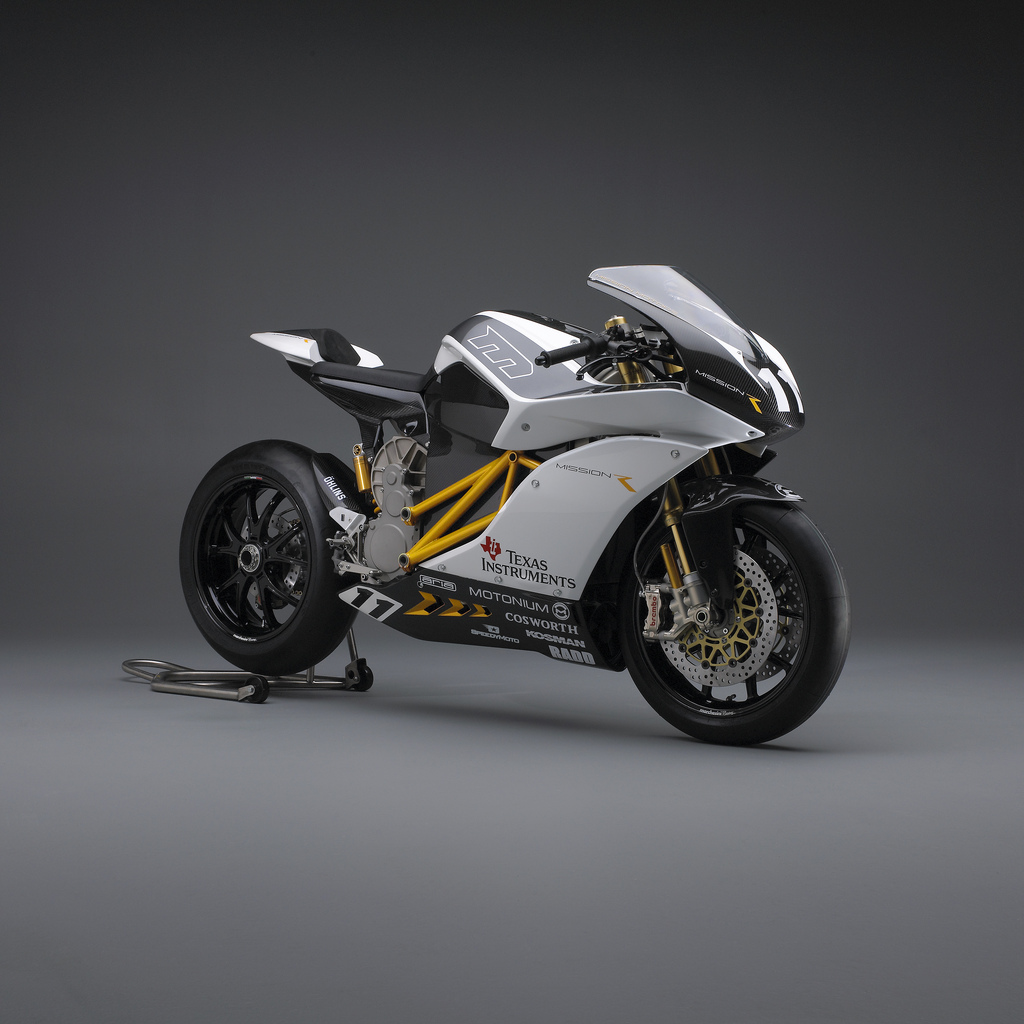
Last December, San Francisco's Mission Motors unveiled its striking, third-generation Mission R electric 'superbike' racing machine and told the world it would be contesting the U.S. TTXGP racing series. The company didn't mention the fact that the battery pack on the Mission R was, at that point, still a mock-up.

Two weeks before the first U.S. TTXGP race (May 15, at Infineon Raceway, just north of San Francisco) I heard that the bike had yet to turn a wheel on the track; Mission was cutting it fine. A week before the race, I was told that it might be displayed at the track, but that it certainly wouldn't be entered after problems were encountered on the dyno. Sure enough, last weekend the bike was displayed in the paddock, but it never left it's track-stand. (Lightning Motors was another prominent DNS at the event.)
You know you want one. There were a few commentators - me included - who felt that the Mission R was the bike that made electric sportbikes relevant. The question is: Will it ever see serial production? I think not.
This could be seen as business as usual for Mission which, like many startups, has a history of releasing impressive specs, then failing to deliver. In nearby Silicon Valley, where Mission recruits a lot of engineers, there's three main industries: companies produce computer software, hardware, and vaporware. But in Mission's case, the delay's not just a case of a company taking a little longer to fulfill promises. I believe it reflects a whole new, uh, corporate mission...

A history lesson

The company now known as Mission Motors was formed in 2007 as Hum Cycles. The founders were Forrest North (CEO), Edward West (President), and Mason Cabot (VP Engineering). Although most of the core group had worked on electric car projects in university, U.S. regulations make putting a new car on the road a lot more expensive than homologating a motocycle. (Crash testing a car costs several million dollars alone.)

Seeking a quick, easy, and affordable point of entry into the EV business, Hum Cycles' first project was to strip the motor and gas tank out of an old Ducati supersport bike, and pack it with batteries and an electric motor. That was shown at a Bay Area 'green technology' fair, to attract some initial investment.

In the winter of 2009, the company - by then renamed Mission Motors - released images of the Mission One, a sci-fi looking motorcycle designed by Yves Behar, best-known for styling personal computers. The company said that within the year, it would be selling bikes with a 150mph top speed and a 150-mile range. The rest of the fledgling electric motorcycle industry scoffed at those claims. No one laughed at the price, though. The Mission One was to sell for almost $70,000.
I didn't hate the Yves Behar-penned Mission 1 quite as much as some people, and I have to say that back when Mission still let me attend their tests, I got some pics of it that made it look as good as it could possibly look. Still, the rap on the second-gen Mission prototype was - lots of claims, no deliveries.
The Mission One put in an under-whelming appearance at the Isle of Man TT in 2009. Tom Montano finished fourth in the TTXGP 'Pro' class with an average speed of 74 mph. To make matters worse, the worst recession in memory had brought motorcycle sales to a screeching halt. It was the wrong time to be taking deposits on a motorcycle with strange styling, questionable performance, but the unmistakable price tag of a Desmosedici.

Mission went back to the drawing board in 2010, bringing in well known American motorcycle designer James Parker and stylist Tim Prentice to pen the all-new Mission R.

That was then, this is now...

As an outsider looking in, it seemed to me that the company was learning that investment capital buys seats on corporate boards, and that investors often take a far more sanguine view than engineers do, of passions like motorcycling in general, and racing in particular. Forrest North was moved out of the CEO's office in February, 2010. He remains on the company's Board of Directors, but isn't talking publicly about his change of status, or Mission's strategy going forward.
Development rider, and Bay Area TT stalwart Tom Montano poses with then-CEO Forrest North. The latter is still nominally on the Mission board, but with Mission's Silicon Valley-style secrecy cult, it's safe to say he won't be talking about the company's change in strategy.

Last winter, the normally-secretive company let slip that it had provided systems for a Honda Civic hybrid car that was racing in California. At that time, I wondered if we were seeing a shift in emphasis from Mission Motors as a freestanding motorcycle manufacturer, to Mission Motors as a designer or supplier of powertrain components for the auto industry.

The appearance of the Mission R at Infineon Raceway last weekend seems to suggest that Mission Motors still has two-wheeled aspirations, but appearances can be deceiving. Stylist Tim Prentice told me that while he has ideas about what a 'street' version of the race bike would look like, there hadn't been much interest at Mission. Really? Most motorcycle companies design a street bike then give thought to the version they'll race.

One employee told me, "I'd be fired if they heard me say this, but there are two factions inside Mission. One faction still loves bikes, and the other doesn't care about them at all. The group that love bikes are not the ones who are in positions of influence."

A couple of months ago, I got an email with an interesting attachment. It was a PowerPoint presentation that Mission had obviously prepared for potential investors. No contractor or freelancer would have access to such material, so the leak must have some from inside Mission, although by the time I got it, I had no way of knowing who, at Mission, wanted the presentation leaked. What was noteworthy about it was that in the first ten pages of the 25-slide presentation, there were over 20 photos of cars before the first photo of a bike appeared, and that was under the heading, 'Concept Vehicle.'

On one slide, under the heading 'Leadership,' seven employees and board members are listed, including David Moll, of the venture capital firm Infield Capital, but none of the original founders are mentioned.

Although the PowerPoint deck I received was intended as visual support for a presentation that Mission's management would have made in person, and is as such not a comprehensive expose of the firm's strategy, it's clear that motorcycles represent a negligible part of the company's plans, and that in fact the largest 'motorcycle' role envisioned is as a powertrain supplier for an unnamed 'Major Powersports Manufacturer.' The implication is that some frustrated member of the 'bike-loving' faction inside Mission wanted to leak the news that the company was not really in the motorcycle business any more.

At the end of the presentation, there's a slide which explains the "Purpose of [the] Mission Motorcycle" that almost reads as an excuse, to potential investors, for a vehicle that could seem frivolous. Mission cites four reasons for continuing the Mission R progam: That it provides a platform for development, demonstrates performance, builds the Mission brand, and helps to recruit top engineering talent. On the same slide, the company almost sheepishly promises to finance racing efforts through sponsorship, and sell the motorcycle ("at high margin") at the end of the year.

Neither Mission Motors, the company, nor Mission R, the motorcycle, 'demonstrate performance' by failing to make an appearance on the grid at Infineon. Since they've got a cooling system for their motor, and because the battery part of the equation seems well-understood, my guess is that the problems were encountered in the controller and software that regulate the power to make the bike rideable and manage battery life. This is a common teething problem with electric vehicles; I'm sure it would have been solved if Mission's engineers had been able to test the bike on a dyno a few weeks earlier.

As I write this, I assume the Mission R will race at the combined FIM ePower/TTXGP event at Laguna Seca later this summer. But that racing effort is intended to prove Mission's technological prowess - mostly to car manufacturers. They won't be racing to create demand for a Mission road bike.

Did Mission lose its ambition to manufacture high-performance electric sports bikes because it does not foresee the U.S. motorcycle market rebounding strongly enough to create a viable market for high-priced sport bikes? Did investors tell the company, "OK, you've had your fun with motorcycles. Now it's time to grow up and do cars"? Or did Mission learn, while working on that Honda hybrid car project, that Honda's motorcycle division had a bike in development that would crush the aspirations of any of the upstart, electric-only motorcycle companies?

It's not obvious to me why the company hasn't clarified its long-term strategy in the motorcycle press. Perhaps it feels that it would be perceived as dithering, or that it's cried 'wolf!' once too often by releasing photos of bikes to fanfare in the press, which later prove to be a disappointment on the tarmac.

Either way, you read it here first: No matter how well the gorgeous Mission R performs when it's eventually raced, it's unlikely that you'll ever be able to buy a road-going version. Mission's getting out of the motorcycle business.

Wednesday, May 25, 2011

Harley-Davidson's XRllent Adventure: Jared Mees

In Michigan, 'Buy American' is part patriotism and part a recognition that U.S. manufacturing is still vitally important to the state's economic survival. Admittedly, Harley-Davidson is a Wisconsin - not a Michigan - company, but the core group of AMA Pro flat trackers that hail from the wolverine state all grew up dreaming of racing all-American motorcycles on America's iconic dirt tracks.

One of those guys is Jared Mees. The 2009 GNC champion started racing XR-750s in the twins championship in the days of the 'twingles' and has stuck with them right through the current 32mm-restrictor-plate period. So he's been one of the fastest flat trackers through a period in which the venerable XR has adapted to tighter and tighter rules, all the while facing stiffer and stiffer competition from the likes of Ducati and Kawasaki. Last season was the first time in decades that Harley-Davidson's dominance at GNC twins races was even challenged, but Mees' faith in the Harley is not shaken. Of the XR riders I've chatted with over the last few weeks, he's been the most unabashed defender of Harley-Davidson's bike motor and the company's larger role in the sport of flat track.

As far as the bike's concerned, "The motor configuration for dirt rack is the key," he told me. "The torque and big, heavy flywheel that allow it to hook up 90 horsepower. There are motorcycles out there that make a boatload of horsepower but getting them hooked up is another story."

Traction is what it's all about. For a few years, the search for traction caused teams to 'twingle' their XRs. A twingled XR-750 fired both cylinders at almost the same time, so that it rode like a massive single. The widely-spaced power pulses allowed the rear tire maximum time to find traction. (Twingling was, from a traction point of view, exactly the same thing Grand Prix roadracing teams did when they adopted 'big bang' motors.)

"They sounded terrible," Mees told me. "But they were a lot easier to ride on the slipperier half-miles. They were banned because people said the twingles were wearing parts out too fast, but it depends on who you talk to." When they were banned, Mees' tuner, Johnny Goad, quickly came up with a permutation of crank weight, compression, cam timing, exhaust tuning - the usual mix of XR science, art, and alchemy - that gave Mees a pretty good edge. It helped that Mees had good throttle control even as an up-and-comer; he chased Kenny Coolbeth to second place in the GNC in the first post-Twingle season (which, if memory serves, was '07) and between the two of them they won almost all the half-mile events.

"The engine's been around for so long that you'd think everyone would know all the tricks," he told me. A small handful of guys - Mike Stauffer, Phil Darcy, Ron Hamp - do almost all the headwork, for example. "But," Mees added, "There are always a few tricks people keep on the down low."

Although he doesn't sugar-coat the issue of parts costs, or the life-expectancy of a built XR-750, Jared sees another side to those high costs, and that's Harley-Davidson't consistent investment in pro flat track. "Sure, you could build a Kawasaki like Bill Werner's for a lot less than a Harley," he told me, and I could hear the frustration in his voice as he added, "But Kawasaki won't give you any help. I'm not knocking Kawasaki, it's a great company and they make great bikes, but they post contingency for WERA and CCS road races that are just club races, and they still won't put up money in our Singles championship - a national championship that Kawasaki riders have won for the last two years. I mean, what do we have to do?"

"So on paper, the 650 Kawasaki is cheaper to run. But you can't walk into a Kawasaki or Ducati dealership and get any support. Meanwhile, the top ten [GNC] guys all seem to be supported by a Harley-Davidson dealership. So the parts are expensive, but if you're getting some for free or at a discount through a sponsor - I get great support from Blue Springs Harley-Davidson - and if I finish in the top 10, I get contingency money from Harley," he told me. "For me, it's a no-brainer."


Tuesday, May 24, 2011

Pikes Peak winner, stunt star Greg Tracy stars as self in Hot Wheels promo

One of my favorite people, Hollywood stunt star Greg Tracy, appears as himself in this brilliant Hot Wheels promo directed by Mouse McCoy, of 'Dust to Glory' fame. Yeah, baby!

Monday, May 23, 2011

Ariel Warfare

When I interviewed Homer Knapp last winter, he mentioned a friend of his, Chuck Walton. Chuck, who is 81, is still the go-to guy when it comes to Ariel Square Fours here in the 'States. Homer casually told me that back when Chuck flew cargo planes for the U.S. Air Force, he frequently brought Square Fours back from the U.K. on military flights.

At that point in our chat, what I was thinking was, "Are you serious?!? If he'd been caught he'd've been court-martialed!" But I didn't blurt that out because I didn't want Homer to clam up, or call his friend and warn him that he'd been outed.

So instead I casually asked, "How many did he bring over?"

"Oh, hundreds." said Homer. Again, I played it cool, because I wanted to call and catch his friend unawares. I loved the idea of an avid motorcyclist bootlegging motorcycles in military aircraft; it was right out of Catch-22. I made a point of looking Chuck up; he was easy to reach through the Ariel Motorcycle Club of North America, where they've known him since the 1960s.

He grew up on a farm in Illinois, so being handy with equipment came with the territory. He was too young to serve in WWII, but his older brother was selected for pilot training. After the war, his brother (stationed at March Field in Riverside) invited Chuck out to California.

"That was it," he told me. "Mom and Dad lost the boys off the farm."
How ya' gonna' keep 'em on the farm when they've moved to California and taken up motorsickles?
Chuck got a job working for an oil company, and joined the Air National Guard because they promised to train him as an aircraft mechanic. So on weekends, he trained and worked on P-51s, which is pretty much starting at the top of the heap as far as being a mechanic goes. When the Korean War broke out, they needed him full-time; from then until he retired, he worked as a technician, then flight engineer on Boeing C97 Stratofreighters and Lockheed C-130s.

"The first time I ever heard a Square Four was in 1949. I was on the bus in L.A.," he told me, "and a guy rode past on a motorcycle that sounded like nothing I'd ever heard. It sounded like an Offenhauser-engined sprint car. I saw the bike turn a corner a couple of blocks ahead, and I jumped off the bus. That was when I found Johnson Motors; they were the Ariel distributor on the west coast."

He finally bought a new Mk II - a four-piper - in '57. Before he'd put 3,000 miles on it, he realized it was going to take a bit of work to make it reliable. The alloy castings were crap; studs pulled out, valve seats and guides came loose, they had oiling problems, and cooling was marginal at best in that warm climate. Incidentally, he still owns his Mk II, along with one of each Ariel model.
Yes, that is an Ariel Square-4 with a sidecar carrying... an Ariel Square-4. Or should I say, 'Spare-4'?
Not long afterwards Ariel ceased production of the fours. The bikes had never been too common in the U.S., and parts got scarce - especially for guys like Chuck, who looked at every traffic light as an opportunity for a drag race. In the early '60s, a couple of Southern California guys started the Ariel club, and Chuck showed up for the second meeting.

"At first, they told me I would have to start out as an 'associate member'," he recalled. "But as soon as they realized I was flying to England every few weeks, they made me a full member."

As we talked, he got around to telling me that from 1960 to 1990, he made hundreds of flights back and forth between the U.S. and the U.K.

"Oh," I asked coyly, "did you bring any of your bikes back from England?"

"Some of 'em, yeah."

When I pressed him for details, he got a little cagey, claiming "I only brought parts. The customs guys gave you a lot of grief if they saw an entire motorcycle; you had to have the log book and there was a ton of paperwork."

Chuck claims it was all above board; everything was scrupulously listed on the manifest as 'motorcycle parts.' Of course, if you can rebuild a P-51, you can break down an Ariel Square Four and reassemble it in your sleep. Not that he was sleeping much. "I'd be awake for three days straight, running around buying stuff," he recalled. "In the '60s, in England, nobody wanted Ariel stuff. I'd see an ad, and go to find bikes rusting under the eaves."

By the 1980s, it was getting harder to bring disassembled motorcycles back in military cargo planes. This would be a better story if Homer's guess that his friend brought 'hundreds' of bikes back was true, but I'm sure that he didn't bring nearly that many. Still, by Chuck's own count he's rebuilt nearly a hundred Square Fours for club members, and it's safe to say that many of them are running thanks to parts airlifted in, courtesy of the unwitting United States Air Force.

Then, Chuck dropped an intriguing bombshell of his own. You see, while customs officials inspected returning cargo flights, they lacked the security clearance needed to inspect the bomb bays of the Strategic Air Command's B-52 nuclear bombers.

"It got to be more trouble than it was worth for me to bring stuff in," Chuck told me. "But the SAC guys used to tie stuff up in their bomb bays."

At the thought, I imagined war breaking out and a routine SAC flight being diverted to bomb Moscow. I pictured the Russkies being pelted with motorcycles.

"Vott iss ziss?" Ivan would wonder. "Iss itt aerial vorrfare, or Ariel vorrfare?"

Friday, May 20, 2011

Notes from the Blue Groove: Historical background to Harley-Davidson's XRllent adventure...

The origins of the current Harley-Davidson XR-750 date back to the Great Depression. Until the early 1930s, the fastest, factory-backed motorcycles ridden by pro riders were single-cylinder 30.50 cu. in. Class A machines. Those bikes were too expensive to race in the Depression, however. Even the big factories like Harley-Davidson and Indian dramatically cut back support for Class A.

Faced with the need to either introduce new rules to control costs, or watch fields wither and die, the AMA Competition Committee published new Class C rules in 1933. Those rules allowed production-based 45 cu. in. side-valve twins to race against 30.50 cu. in. overhead-valve bikes, provided those machines had compression ratios of less than 7.5:1.

For the next 30 years, the governing body of American motorcycle racing pretty much unabashedly maintained rules that favored American-made motorcycles, or at least allowed U.S. manufacturers to field competitive machines with minimal research and development costs. By the 1960s, however, America's motorcycle landscape was changing while the rules stayed the same. Class C competition was by then a straight us-versus-all-the-rest-of-them fight in which 750cc, V-twin side-valve Harley-Davidson KRs raced against 500cc or smaller overhead-valve singles and twins imported from Britain, Europe and, increasingly, Japan.
This minimalist KR from the late '50s betrays some creative drillwork. Every ounce counts!
By 1967 (a boom year for U.S. motorcycle sales) Honda commanded a 50% market share, but there was still no Japanese representation on the MS&ATA (by then the 'Motorcycle and Allied Trades Association had somehow become the 'Motor Scooter and Allied Trades Association'. No matter what name it went by, it was the industry's main voice in the AMA.

The major Japanese importers formed their own trade association, the Southern California Motorcycle Safety Council. The name was innocuous, but when it attracted the interest of the British importers, too, the AMA realized that if it didn't level the playing field by changing the eligibility rules for Class C, the SCMSC would probably start sanctioning its own races.

The AMA Competition Congress met in the fall of 1968, to propose new Class C rules for the upcoming season. The 'import' bloc initially proposed raising the displacement limit for OHV motors to 650cc. Walter Davidson then countered with a motion proposing a limit of 750cc. This would seem to have been against Harley-Davidson's interests, but his thinking was that it would be easier for Harley-Davidson to develop a 750cc OHV race motor based on the existing KR design than create a new 650cc twin from scratch. That was put to a vote, and I can picture the 'import' delegates scratching their heads as they agreed to it. Then, Davidson immediately moved to delay the implementation of the rules until 1970 in order to give The Motor Company time to field a new bike. That was voted down. Those revised Class C rules still form the basis of the rules which now define racing motors in the GNC Twins class.

Walter Davidson might have envisioned a new OHV version of the KR (a production racer that had been made in both a flat track and KRTT road-racing versions for almost 20 years at that point.) But in fact, Harley's OHV racing twin was based on the 883cc Sportster street bike. Dick O'Brien, who ran the Harley race shop as a sort of personal fiefdom, and Pieter Zylstra (a H-D engineer) destroked a Sportster motor, producing an 'iron-head' XR for the 1970 season.

It was not, by any means, an overnight success. The top end couldn't dissipate the heat produced in racing. But Harley-Davidson cast alloy heads and made cylinders with a larger finned area. The alloy XR was a potent weapon on flat tracks, and the XRTT road-racing version was good enough for Mark Brelsford to win the (then combined) AMA Grand National Championship in 1972.

Harley-Davidson produced complete XR race bikes in limited quantities until 1980. By then, independent frame-builders were producing better chassis, and the factory saw no point in making and selling frames that weren't being used. In the late '80s, Harley stopped assembling XR motors, since by that time when teams took delivery of a new motor, they took it apart and tweaked it anyway.
By the mid-'70s, the modern XR-750 had (twin shock) rear suspension and a rear brake, to go with those newfangled overhead valves. Its teething problems over, it would go on to dominate the GNC for 30+ years.
 Except for the few years in which Honda created its own version of the XR - and an even-shorter period in which a few Japanese manufacturers fielded flat track bikes powered by two-stroke road racing motors - the XR has dominated GNC flat track racing ever since. It's pretty much accepted wisdom that the same uneven firing order that gives the Harley its characteristic 'potato-potato' sound at idle gives it a natural 'big bang' firing order that helps it to hook up on a dirt track.

In future Blue Groove installments, I'm going to check in with some respected XR tuners to find out what other advantages the XR offers, and what has to be done to minimize some of its disadvantages - not the least of which is the rule specifying 32mm restrictor plates.